Apr 15, 2026
Wealth That Outlives You: Designing a Diversified Portfolio with Generational Legacy in Mind

Key Takeaways
Wealth that outlives you encompasses both financial capital (stocks, bonds, real estate, businesses) and spiritual/relational capital (values, work ethic, financial literacy). From Third Act Retirement Planning’s biblical stewardship viewpoint, true legacy building treats assets as entrusted resources meant to bless multiple generations.
Diversification for generational wealth means blending public markets, private assets, and intentional estate structures—not simply owning “a lot of different funds.” This requires coordinating investments across asset classes, tax treatments, and time horizons spanning 50-100 years.
Studies show that 70% of wealth dissipates by the second generation, and up to 90% is gone by the third generation. The antidote is coordinated investment, tax, and legacy planning that prepares both the portfolio and the heirs.
Sudden-wealth families—those receiving inheritance, business sale proceeds, NIL deals, or legal settlements—face amplified risks including overspending, tax inefficiencies, and poor investment choices. A fee-only fiduciary financial plan can substantially reduce these dangers.
This article provides a practical framework you can start applying in 2026, covering mindset, diversification principles, portfolio components, tax and estate design, and heir preparation. Those wanting hands-on guidance are invited to schedule a discovery call with Third Act Retirement Planning.
Introduction: From Windfall to Multi-Generation Stewardship
Picture a 52-year-old in Marietta, Georgia, who just closed on a $3.5 million business sale in late 2025. Or perhaps a 58-year-old who received a $1.2 million inheritance after her mother’s passing in 2024. Both are asking the same question: Should I upgrade my lifestyle now, or can this money become something that blesses my family for decades?
This tension sits at the heart of what we call “wealth that outlives you.” It’s the art and discipline of stewarding a windfall or accumulated savings so it benefits children, grandchildren, churches, and causes long after the original owner’s lifetime, with careful planning that prioritizes the family's future.
Proverbs 13:22 puts it plainly: “A good man leaves an inheritance to his children’s children.” This ancient wisdom connects directly to modern financial planning—building wealth isn’t just about your retirement, but about creating generational wealth that serves future generations.
At Third Act Retirement Planning, we’re a fee-only fiduciary firm in Marietta, Georgia, specializing in sudden-wealth clients. We integrate biblical wisdom into retirement, tax, and legacy planning because we believe comprehensive financial planning should address both the numbers and the purpose behind them.
In this guide, you’ll learn how to adopt a generational legacy mindset, apply core diversification principles, construct a portfolio with multiple asset categories, design tax-efficient estate structures, and prepare your heirs to inherit wisely. Let’s build a financial plan that truly lasts.

1. Adopting a Generational Legacy Mindset
Effective diversification starts with purpose. Without a clear “why,” even well-built portfolios get dismantled by the next generation—sold off for short term gains or drained by poor decisions. Your financial future depends on establishing this foundation first. It’s essential to focus on sustainable, long-term wealth creation and financial education to ensure your legacy endures.
Generational legacy means more than accumulating money. It includes values, work ethic, charitable priorities, and faith practices that help future heirs handle wealth wisely. The most successful wealthy families combine enduring assets with passed-down financial principles and family governance structures.
This requires thinking in 50-100 year terms across multiple generations rather than just to one’s own retirement date. When you extend your planning horizon, your risk tolerance, investment choices, and estate structures all shift accordingly.
Families who frame themselves as stewards rather than owners tend to save more, stay invested through market volatility, and communicate better with heirs about money. This stewardship mindset—viewing assets as entrusted temporarily—not only preserves the family's legacy but is also both biblically grounded and practically effective for building wealth that endures.
Third Act’s Approach: We practice Kingdom-focused stewardship, helping clients maximize impact rather than just account balances. This means aligning investments, giving, and legacy structures with your deepest convictions.
Think in Generations, Not Just Retirement Dates
Retirement plans built solely around a single “target date” (like 2035 or 2040 funds) often become too conservative for assets meant to last for grandchildren born in the 2010s-2020s. A target-date fund designed for someone retiring in 2035 will have de-risked significantly by 2040—far too conservative for money that needs to grow through 2060 or beyond.
To start building generational wealth, define explicit multi-generational goals:
Funding grandchildren’s college through 2050
Sustaining annual charitable gifts for decades
Leaving a lasting legacy for your children’s children
Consider splitting your capital into time-horizon buckets:
Time Horizon | Purpose | Investment Approach |
|---|---|---|
2026-2040 | Current retiree’s spending | More bonds/cash, conservative |
2041-2060 | Children’s inheritance | Balanced growth |
Post-2060 | Grandchildren/ministries | Equity-heavy, long term growth |
This structure ensures money needed soon stays safe while legacy capital can compound aggressively over decades.
From Ownership to Stewardship
The stewardship mindset changes everything. When you view assets as entrusted for a season rather than ultimately “yours,” it encourages prudence, generosity, and long-term thinking over competing priorities like lifestyle inflation.
This perspective shifts decisions about:
Big purchases after a windfall — Is upgrading to a $2 million home really necessary, or would that capital serve the family’s future better invested?
Investment speculation — Chasing high-risk bets feels different when you’re stewarding your family’s legacy
Inheritance structures — Trusts with guardrails make more sense than outright gifts that could be squandered
Good stewards maintain specific behaviors:
Keep an updated written financial plan reviewed annually
Stress-test portfolios for market downturns (like 2008 or 2020)
Review giving and legacy goals each year with family
Ask yourself: Would your current spending, investing, and giving patterns make sense if your grandchildren were watching over your shoulder in 2060?
2. Core Principles of Diversification for Generational Wealth
“Diversification” is often misunderstood as simply having many funds. For legacy planning, it means spreading risk across asset types, time horizons, and tax buckets in ways that preserve purchasing power for decades.
Three key dimensions define proper diversification:
By asset class: Stocks, bonds, real estate, alternatives
By tax treatment: Taxable, tax-deferred, tax-free
By purpose: Income today vs. growth for heirs vs. charitable capital
Portfolios designed to outlive the original owner must preserve purchasing power against inflation over decades while withstanding corrections without forcing panic selling. Consider that the 2008 crisis saw a 50% equity drop, the 2020 COVID crash produced a 34% S&P decline, and 2022’s inflation surge caused bond losses exceeding 10%. A concentrated portfolio cannot survive this kind of market volatility across multiple generations.
Third Act Retirement Planning uses evidence-based, low-cost diversified portfolios coordinated with tax and estate strategies. We don’t sell commission-based products—our fee-only structure means our recommendations serve your interests alone.
Balancing Growth, Income, and Protection
A generational portfolio blends three elements:
Growth assets: Global equities for long-term compounding (historical real returns of 6-7% annually)
Income assets: Investment-grade bonds, real estate rental income
Protection tools: Cash reserves, short-term treasuries, insurance
Here’s an illustrative allocation for a hypothetical family legacy pool:
Asset Class | Allocation | Role |
|---|---|---|
Global Equities | 60% | Long-term wealth building |
Investment-Grade Bonds | 25% | Stability and income generation |
Real Estate | 10% | Appreciation and tax advantages |
Cash/Short-Term | 5% | Emergency reserves |
Actual allocations should be customized to your situation. Younger heirs and longer timeframes justify higher equity exposure for legacy portions, while the retiree’s personal spending pool should be more balanced or conservative.
The goal isn’t avoiding volatility entirely—it’s ensuring essential spending and near-term goals are insulated from market swings so long-term assets can stay invested through corrections.
Diversifying Across Tax Buckets
Building financial assets in three main tax categories provides flexibility for you and your heirs:
Taxable brokerage accounts: Step-up in basis benefit at death
Tax-deferred accounts: Traditional IRAs, 401(k)s with required distributions
Tax-free accounts: Roth IRAs, certain permanent life insurance structures with cash value
The 2025 TCJA sunset makes proactive tax planning especially urgent. Federal exemptions are scheduled to drop from approximately $13.61 million per person to roughly $7 million after 2025, and tax rates will increase.
Example: Spreading $2 million across tax buckets allows heirs to withdraw funds strategically in the 2030s and 2040s. They can pull from taxable accounts when in lower brackets and preserve Roth assets for higher-earning years.
Third Act Retirement Planning routinely models long-term tax outcomes so families can intentionally fill lower tax brackets today. Proactive Roth conversions in low-bracket years can reduce lifetime taxes by 20-30% for multi-million-dollar estates.
3. Building the Portfolio: Key Asset Categories for a Lasting Legacy
No single asset can carry a legacy alone. Enduring wealth comes from a coordinated mix of liquid market assets, tangible properties, business interests, and strategic insurance. Here’s how each category contributes to a 30-70 year wealth creation plan.
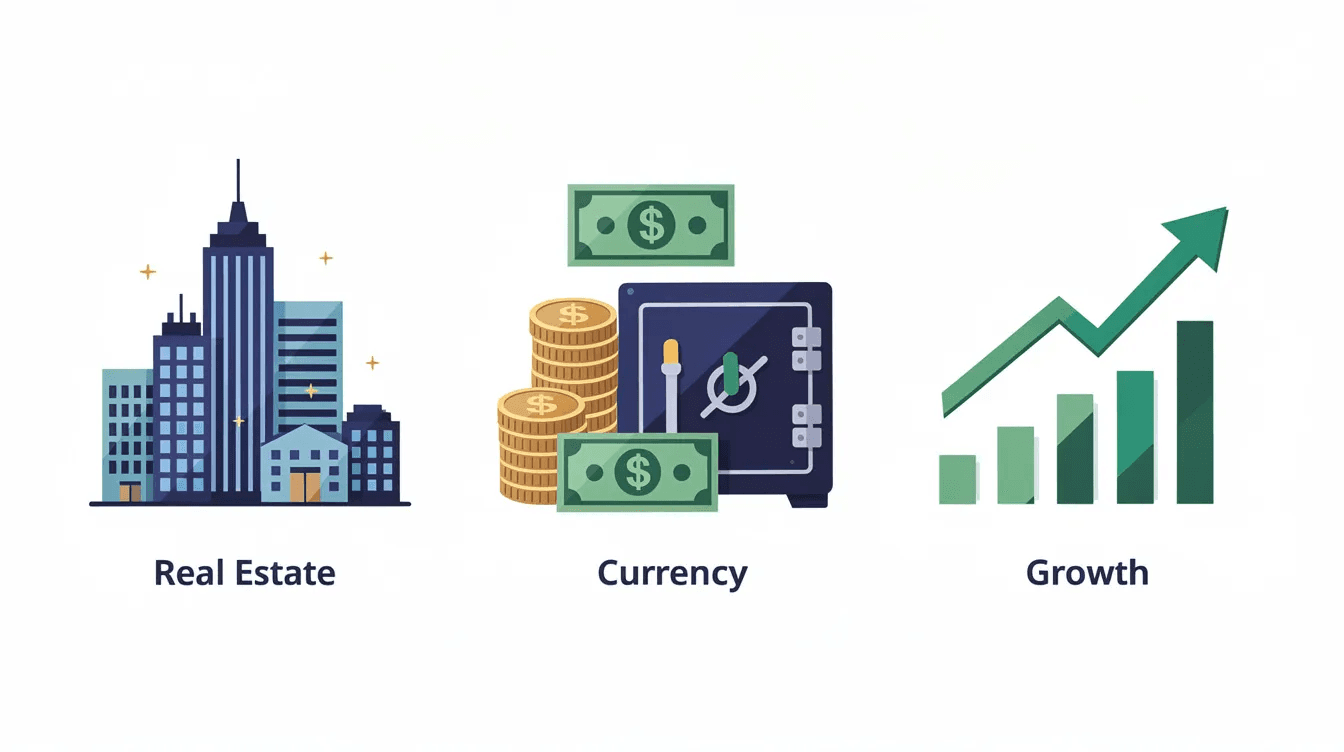
A caution before diving in: over-concentration destroys generational wealth. Too much in a single rental property, too much in company stock, or illiquid private deals that heirs can’t access—these are common ways families lose wealth despite having substantial assets on paper. In fact, wealthy families lose a significant portion of their wealth by the second and third generations due to inadequate planning, lack of education, and poor governance.
Global Stocks and Equity Funds
Equities have historically been the main driver of inflation-beating financial growth over long periods. For wealth intended to last to 2050 and beyond, they’re essential.
Rather than trying to pick individual “hot” stocks, use diversified vehicles:
Low-cost total market index funds
Broadly diversified ETFs covering U.S. and international markets
Target allocations of 60-80% equities for legacy-designated accounts
The math matters: A $1,000,000 diversified equity allocation compounding at 6-7% real (after inflation) return grows to $5.7-7.6 million by 2056. That same million sitting in cash barely keeps pace with inflation.
For legacy-designated investment accounts, volatility in any single year (like 2022’s 25% drawdown) matters far less than disciplined compounding across decades. This requires emotional resilience and a clear legacy plan that keeps you invested when markets drop.
Bonds, Cash, and Fixed-Income Reserves
High-quality bonds and cash-like holdings stabilize your portfolio. After 2022-2023 rate hikes, Treasuries now yield 4-5%—a meaningful return for conservative capital.
Fixed income serves critical functions:
Funding known expenses in the next 5-10 years
Preventing forced sales of equities during downturns
Providing income generation during retirement
Consider a “bond ladder” covering planned withdrawals from 2026-2031:
Maturity Year | Purpose |
|---|---|
2026 | Year 1 living expenses |
2027 | Year 2 living expenses |
2028-2031 | Subsequent years |
This structure allows equity portions to remain focused on long-term legacy while your near-term needs stay protected.
Warning: Avoid chasing high-yield junk bonds or complex structured products for legacy capital. Credit risk and opacity can threaten multi-generational stability. Stick with investment-grade bonds and Treasuries for this portion.
Real Estate and Tangible Assets
Real estate can be a pillar of generational wealth when managed prudently. Benefits include:
Rental income (typically 4-6% yields)
Long-term appreciation (3-4% annually)
Tax advantages like depreciation and 1031 exchanges
However, risks require careful planning:
Concentration in a single local market (remember 2008 foreclosures)
Leverage that strains cash flow when rates rise
Heirs who don’t want to manage properties in the 2030s-2040s
Many families benefit from holding a portion of their legacy in professionally managed REITs or diversified real estate funds. These provide similar exposure with better liquidity—crucial when heirs need to manage wealth without property management headaches.
Business Interests and Private Investments
Ownership stakes in closely held businesses can create outsized wealth. This is especially relevant for clients who recently sold a company or retained minority interests after a 2024-2025 exit.
Critical requirements for business interests as legacy assets:
Written buy-sell agreements
Clear succession planning
Professional valuation work
Asset protection structures
Without these, heirs can be left with unmarketable or disputed assets that destroy family relationships.
Allocation guidance: Limit illiquid investments (private equity, angel investments, business interests) to 10-20% of total legacy capital. These require careful planning and clear understanding of risks and timelines.
Third Act Retirement Planning helps sudden-wealth clients evaluate whether to reinvest proceeds back into new ventures or diversify into more liquid holdings that better serve multi-generational goals.
Insurance and Guaranteed Income Tools
A life insurance policy with permanent life insurance structure can serve specific legacy purposes:
Tax-free death benefit for heirs
Liquidity for estate taxes or equalizing inheritances
Funding charitable bequests
Certain annuity structures can secure baseline retirement income for the first generation, allowing other portfolio segments to stay growth-oriented for heirs. A well-structured death benefit ensures the next generation receives assets regardless of market conditions.
Critical evaluation points:
Policy costs (1-2% annual fees are common)
Guarantee strength and insurer ratings (A+ or better)
Integration with the entire financial plan
Avoid “product first, plan later” sales approaches. As fee-only fiduciaries, Third Act Retirement Planning evaluates existing policies and coordinates with outside insurance professionals when appropriate—we don’t earn commissions on recommendations.
4. Designing with Taxes, Estate Structures, and Charitable Giving in Mind
Without proactive tax planning and estate planning, a large portion of multi-million-dollar estates can be lost to federal and state taxes, fees, and avoidable delays. The numbers are stark: estates can lose 40-50% without proper structure.
Current estate tax thresholds around 2026 make this urgent. The federal exemption of approximately $13.61 million per person is scheduled to drop to roughly $7 million after 2025. Families with estates approaching or exceeding several million dollars should begin planning now.
Key documents that control how assets move across generations:
Wills: Basic direction for asset distribution
Revocable living trusts: Avoid probate, maintain privacy
Beneficiary designations: Direct transfer of retirement accounts and insurance
Charitable planning—through donor-advised funds or charitable remainder trusts—reduces tax burdens while aligning wealth with biblical generosity and your family’s legacy.
Third Act Retirement Planning partners with estate attorneys and CPAs to implement these strategies. We act as the coordinator keeping investment, tax, and legacy strategies aligned across all professionals serving your family.
Using Trusts to Guide and Protect Heirs
Most families with significant wealth choose to leave larger inheritances in trusts rather than outright. The reasons for asset protection extend beyond taxes:
Creditor protection: Assets in properly structured trusts can be shielded
Divorce protection: Inherited assets stay separate if structured correctly
Guidance on use: Trust provisions can encourage wise stewardship
Specific trust provisions might include:
Provision Type | Purpose |
|---|---|
Age-based distributions | 25% at 30, 35% at 35, remainder at 40 |
Income matching | Trust matches heir’s earned income |
Purpose earmarks | Funds for education, home purchase, or starting a business |
These structures support biblical stewardship principles by encouraging work ethic and wise management rather than entitlement. Trusts must be coordinated with account titling and beneficiary designations so assets actually flow into intended structures.
Coordinating Tax Strategy Across Generations
Long-term tax mapping requires careful planning across these decisions:
Which assets to spend first in retirement
Which assets to leave to heirs
How to utilize Roth conversions before and after 2026 tax changes
Scenario: Parents currently in a 12% tax bracket convert $100,000 from a traditional IRA to Roth. They pay $12,000 in taxes now. If heirs would be in a 24% bracket, that same conversion saves $24,000 in future taxes—and potentially $100,000+ over decades when considering growth.
The step-up in basis rule makes taxable accounts particularly valuable for wealth transfer. Unrealized gains are erased at death, allowing heirs to sell appreciated assets tax-free. This may make taxable accounts more advantageous to pass wealth than tax-deferred accounts with required distributions.
Aligning Charitable Giving with Legacy Goals
Strategic charitable giving isn’t an afterthought—it’s a central pillar of legacy from a biblical perspective. Generosity is a purpose of wealth, not a competing priority.
Tools for tax-efficient giving:
Donor-advised funds (DAFs): Immediate deduction, flexible timing of grants
Charitable remainder trusts (CRT): Income stream to donor, remainder to charity
Qualified charitable distributions: Up to $105,000 tax-free from IRAs after age 70½ (2026)
Consider involving adult children in giving decisions through annual family meetings where everyone helps choose ministries to support. This cultivates shared vision, purpose, and financial literacy across generations.
Third Act Retirement Planning helps clients structure giving plans that fit both convictions and overall retirement and legacy math.
5. Preparing the Next Generation to Inherit Wisely
Most large inheritances fail not because of market performance but because heirs lack preparation, communication, and shared values. Studies indicate that 90% of wealth is gone by the third generation—and it’s rarely the investments that fail.
Portfolio design alone cannot carry a family’s legacy if the next generation is unprepared to manage wealth and steward it. Intentional financial education and conversation are essential.
View teaching financial literacy and family communication as part of the “asset mix” you’re building. They’re just as critical as stocks and real estate for ensuring your family’s future.

Third Act Retirement Planning often participates in multi-generational meetings to explain plans, answer questions, and reinforce stewardship principles for children and grandchildren. Transparency now prevents conflict later.
Family Conversations and Governance
Age-appropriate money conversations should cover:
The purpose of the family wealth
Expectations for heirs
Guardrails built into trusts or gifts
Why certain decisions were made
Create a simple “Family Financial Mission Statement” capturing core values:
“Our family wealth exists to honor God, provide for our needs, bless future generations, and serve others generously. We value work, prudence, generosity, and faith. We are stewards, not owners.”
Revisit this statement annually. Consider establishing a family council or annual meeting where giving decisions, investment updates, and legacy goals are reviewed together.
Transparency—at least at a summary level—reduces surprise, resentment, and decision making conflicts when estates are eventually settled. Many families who lose wealth do so because heirs were caught off guard or felt excluded from planning.
Teaching Practical Money Skills to Heirs
Concrete skills to pass down include:
Budgeting: Living within means regardless of inheritance
Investment basics: Understanding market cycles and long-term investing
Reading statements: Knowing what they own and why
Working with advisors: Engaging as an informed client, not passive recipient
Start early with small steps. Involve teenagers and young adults in investing decisions—fund a Roth IRA with part-time job earnings in 2026 and choose low-cost index funds together.
For sudden-wealth heirs (NIL athletes or young adults inheriting in their 20s-30s), require a written spending and savings plan before lifestyle decisions escalate. The one time event of receiving significant money can quickly become a one generation story of wealth transfers fail without this structure.
Third Act Retirement Planning can create structured education plans for heirs, including joint meetings and teaching materials aligned with biblical financial wisdom.
6. Putting It All Together: Your Next Steps in 2026
Building wealth that outlives you requires four integrated elements:
A clear legacy mindset
Diversified investments across asset classes and tax buckets
Coordinated tax and estate structures
Prepared heirs with knowledge and values
Your 2026 Action Checklist
Action Item | Why It Matters |
|---|---|
Inventory all assets | Know what you have before you can plan |
Define multi-generational goals | Set 30-50 year targets, not just retirement dates |
Review estate documents | Ensure wills, trusts, and beneficiaries are current |
Evaluate investment diversification | Check concentration risks and tax bucket balance |
Schedule family conversation | Begin preparing heirs with transparency |
If you’ve recently experienced a windfall—inheritance, business sale, legal settlement, or NIL income—pause major lifestyle upgrades until a comprehensive financial plan is in place. The decisions you make in the first 12 months often determine whether wealth lasts one generation or three.
How Third Act Retirement Planning Works
Our process guides sudden-wealth families through strategic planning:
Discovery call: Understand your situation and goals
Deep-dive analysis: Evaluate all assets, taxes, and legacy structures
Custom plan: Retirement, investments, tax strategy, healthcare, legacy, and generosity
Ongoing guidance: Annual reviews and adjustments as life changes
As a financial advisor operating on a fee-only fiduciary basis, we’re legally bound to act in your best interest. We don’t sell products or earn commissions—our only job is helping you build generational wealth that serves your family’s future and honors your values.
Ready to turn your current wealth into a multi-generation, purpose-driven legacy? Schedule a discovery call with Third Act Retirement Planning to start the conversation.
FAQ: Designing a Diversified Portfolio for Generational Legacy
How much money do I need to start planning for generational wealth?
There’s no fixed dollar amount required. Even a few hundred thousand dollars can become generational wealth if intentionally managed—a $250,000 inheritance compounding at 7% grows to over $1 million in 20 years. Conversely, multi-million-dollar estates can disappear without a financial foundation in place.
Sudden-wealth situations (a $750,000 inheritance in 2024 or a $2-5 million business sale in 2025) particularly benefit from immediate, holistic planning. Don’t wait until you feel “wealthy enough”—begin aligning investments, taxes, and estate documents as soon as your goals include children or charitable legacy.
Should my legacy portfolio be more aggressive than my retirement portfolio?
Often, yes. Dollars earmarked for children and grandchildren can reasonably accept more equity exposure because of longer time horizons. A 30-year-old heir receiving assets in 2056 has a fundamentally different risk tolerance than a 65-year-old retiree spending assets in 2027.
The key is separating “today’s retirement income bucket” from “long-term legacy bucket” so that near-term spending isn’t dependent on volatile assets. Work with a fiduciary to quantify how much can safely be positioned for multi-decade growth without jeopardizing your current financial life security.
Is paying off all debt the best move for generational wealth?
It depends on the debt. High-interest consumer debt (credit cards, personal loans above 6-8%) typically should be eliminated quickly. But strategic, well-structured debt—like a modest fixed-rate mortgage on a cash-flowing rental property—may actually enhance long-term wealth creation.
When mortgage rates are 3-4% and diversified equities historically return 6-7% real, keeping low-rate debt while investing excess capital may create more value for heirs. Evaluate debt decisions in context of cash flow, rates, risk management tolerance, and your broader financial strategies rather than following a one-size-fits-all rule.
How often should I update my generational wealth plan?
Review the full plan at least annually and after major life events: marriage, divorce, business sale, birth of grandchildren, significant market shifts, or tax law changes. 2025-2026 will be especially critical years due to scheduled federal tax law changes.
Third Act Retirement Planning builds ongoing review meetings into our service model so clients can adjust course while staying anchored to long-term legacy goals. Creating generational wealth requires careful planning that evolves with your life.
Can I still be generous today if I want to build a lasting legacy?
Absolutely. Generosity is fully compatible with building wealth—and from a biblical perspective, it’s a central purpose of wealth rather than a competing goal. The question isn’t whether to give, but how to give wisely.
Thoughtful planning can create sustainable charitable giving through tools like a donor-advised fund seeded in 2026. This blesses ministries now while involving the next generation in stewardship decisions. Discuss desired giving levels with your financial advisor so generosity and multi-generational security are planned together, supporting both your financial foundation and your family’s values.