Mar 31, 2026
Understanding 4 Key Types of Retirement Accounts
Key Takeaways
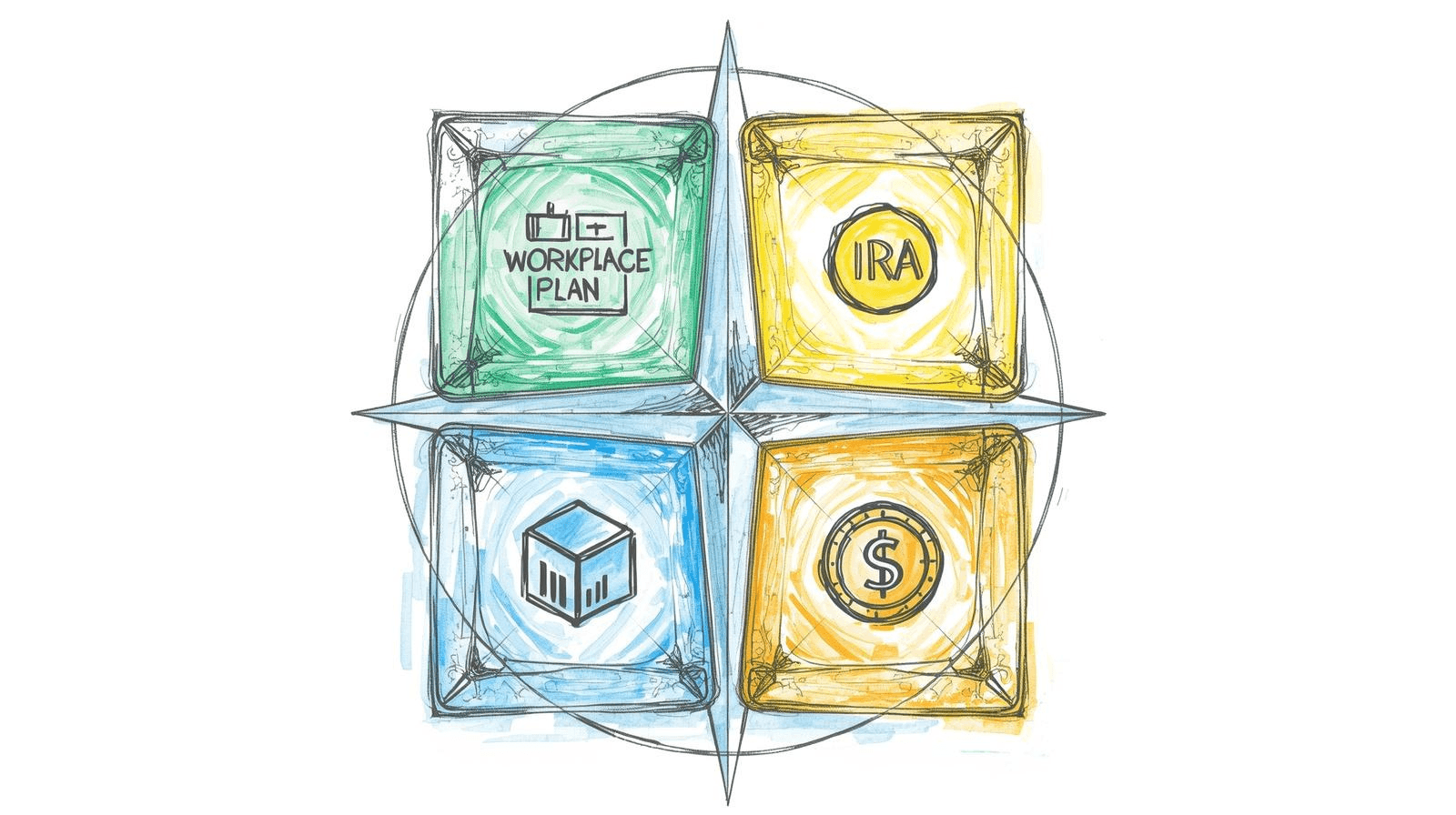
The four key types of retirement accounts are employer-sponsored plans (401(k), 403(b), 457(b)), individual retirement accounts (traditional and Roth IRAs), self-employed plans (SEP IRA and Solo 401(k)), and Health Savings Accounts as a stealth retirement tool.
Each account type offers distinct tax advantages—some reduce your current taxable income, others allow earnings to grow tax deferred, and certain accounts let qualified withdrawals be withdrawn tax free.
Contribution limits for 2024-2025 range from $7,000 for IRAs to $70,000 for self-employed plans, with catch up contributions available at ages 50 or 55 depending on account type.
No single account is “best”—effective retirement planning blends multiple types to diversify tax exposure and support income, generosity, and legacy goals.
At Third Act Retirement Planning, we help sudden-wealth clients organize scattered retirement assets and choose the right mix through fee-only fiduciary guidance rooted in biblical stewardship.
Why Your Choice of Retirement Accounts Matters
After receiving a windfall—whether from an inheritance, business sale, NIL contract, or legal settlement—choosing the right retirement accounts can mean hundreds of thousands of dollars difference over a 20-30 year retirement. This isn’t theoretical. The difference between optimal and suboptimal account selection compounds dramatically when large sums are involved.
A retirement account functions as a wrapper around your investments—stocks, bonds, mutual funds, ETFs. The wrapper itself determines how your money is taxed at contribution, during growth, and upon withdrawal. Two people with identical portfolios can end up with vastly different after-tax retirement income simply because of which accounts hold those investments.
Most Americans build retirement savings through four core account types: workplace retirement plans, individual retirement accounts, self-employed plans, and HSAs. While defined benefit plans (traditional pensions) and taxable brokerage accounts exist, these four tax-advantaged categories form the foundation of modern retirement planning.
At Third Act Retirement Planning in Marietta, Georgia, we help sudden-wealth clients organize scattered accounts and intentionally choose the mix that supports income, generosity, and legacy. Our approach integrates biblical stewardship principles with rigorous, numbers-based analysis. The goal isn’t just accumulation—it’s purposeful preparation for your third act.

Contribution Rules: Limits, Eligibility, and Catch-Up Contributions
Understanding contribution rules isn't just fundamental—it's absolutely decisive for maximizing retirement accounts and capturing every available tax advantage. Each retirement plan type—401(k), Roth IRA, Traditional IRA, or simplified employee pension (SEP IRA)—operates with distinct annual limits, eligibility criteria, and strategic catch-up opportunities as retirement approaches. Mastering these rules eliminates inefficiencies and optimizes your financial trajectory.
401(k) plans and similar employer-sponsored retirement vehicles offer systematic wealth-building power with annual limits of $23,000 for 2024, increasing to $23,500 in 2025. Age 50-plus individuals can execute catch-up contributions of an additional $7,500 annually—a decisive strategy for accelerating retirement accumulation as deadlines approach. These contributions deploy pre-tax dollars strategically, reducing current taxable income and potentially lowering your tax bracket for immediate optimization. Employer contributions—matching or profit-sharing—operate outside your personal limits, making these plans exceptionally powerful wealth-building instruments.
Individual retirement accounts (IRAs) present clear annual contribution parameters: $7,000 for both 2024 and 2025, with strategic $1,000 catch-up contributions available for those 50-plus. Traditional IRA contributions may deliver tax deductions—depending on income levels and employer plan participation. Roth IRAs, conversely, utilize after-tax dollars strategically—no immediate deduction, but earnings grow tax-deferred with qualified retirement withdrawals emerging completely tax-free. Critical consideration: Roth IRAs impose income limits that may restrict high earner eligibility.
Small business owners and self-employed individuals access retirement savings vehicles with superior contribution limits—specifically SEP IRAs and Savings Incentive Match Plans for Employees (SIMPLE IRAs). Simplified employee pensions enable employer contributions reaching 25% of compensation, capped at $69,000 for 2024 and $70,000 for 2025. SIMPLE IRAs deliver annual contribution limits of $16,000 for 2024 and $16,500 for 2025, plus $3,500 catch-up opportunities for those 50-plus. These plans prove exceptionally attractive for maximizing tax-deductible contributions and leveraging superior contribution thresholds.
Catch-up contributions represent decisive tools for age 50-plus individuals, enabling enhanced retirement account contributions and eliminating earlier savings gaps. Strategic example: 401(k) participants could contribute up to $31,000 in 2024 when eligible for catch-up provisions. Combined with employer contributions, this approach significantly amplifies retirement accumulation.
Eligibility requirements operate based on earned income, employment status, and participation in alternative retirement plans. Roth IRAs impose income limitations, while SEP IRAs and SIMPLE IRAs target small business owners and self-employment income specifically.
Mastering and systematically leveraging these contribution rules optimizes retirement savings, maximizes tax benefits, and ensures retirement planning stays decisively on track for long-term objective achievement.
Type 1: Employer-Sponsored Retirement Plans (401(k), 403(b), 457(b))
Employer-sponsored retirement accounts often become the largest retirement assets for people who spent decades in a career. The combination of automatic payroll deductions and employer contributions creates powerful accumulation mechanics that many other accounts simply cannot match. 401(k) plans are employer-sponsored retirement savings plans that allow employees to save and invest a portion of their paycheck before taxes are taken out.
These are defined contribution plans—your retirement benefit depends entirely on what you and your employer contribute, plus investment performance. This differs fundamentally from a traditional pension plan, where a formula guarantees specific payments regardless of market returns and the employer manages the investments. Pension plans are less common today but still provide a defined benefit for some workers.
Current Contribution Limits
For 2024, the elective deferral limit for 401 k plans stands at $23,000, rising to $23,500 in 2025. Those age 50 and older can add $7,500 in catch up contributions in both years. The IRS adjusts these limits annually for inflation, so 2026 will likely bring higher figures. Employer-sponsored retirement accounts often have higher contribution limits compared to IRAs.
The 403(b) plans serving nonprofits, schools, and ministries mirror these limits closely. Similarly, 457(b) plans for local government employees and certain nonprofits share the same basic structure, though 457(b) plans uniquely permit a special catch-up allowing double the standard limit in the three years before normal retirement age.
Tax Treatment Options
Traditional contributions use pre tax dollars, reducing your current taxable income now while creating ordinary income tax obligations on future withdrawals. 401(k) plans allow employees to save and invest a portion of their paycheck before taxes are taken out, deferring taxes until withdrawal. Roth contributions flip this—you contribute after tax dollars with no current deduction, but qualified withdrawals come out completely tax free.
Many workplace plans now offer both a traditional and Roth bucket under the same plan. Starting in 2024, many employer Roth accounts are no longer subject to required minimum distributions during the original owner’s lifetime—a significant planning advantage.
Employer Match and Vesting
Employer match represents free money that can effectively double your contributions instantly. However, these employer contributions typically follow vesting schedules—three to five year cliff or graded structures where unvested portions revert to the employer if you leave before fully vesting. Some plans also include a profit sharing plan feature, where the employer distributes a portion of company profits to employees' retirement accounts, providing an additional source of retirement income.
Early withdrawal rules apply: distributions before age 59½ are generally subject to income tax plus a 10% penalty, though exceptions exist for certain public safety employees, substantially equal periodic payments under Section 72(t), and other specific circumstances.
When changing jobs or retiring, you can roll these accounts into an IRA or your new employer’s plan. Third Act helps evaluate which rollover path best fits your tax and legacy objectives, since employer plans often limit investment options compared to broader IRA choices.
Type 2: Individual Retirement Accounts (Traditional & Roth IRAs)
Individual retirement accounts provide personal control—you open them through a bank, brokerage, or financial institution like Schwab or Fidelity. IRAs work well for rollovers from old employer plans, supplemental savings beyond workplace plans, or as a primary vehicle if you lack an employer sponsored plan altogether.
Contribution Limits and Eligibility
The annual contribution limit stands at $7,000 per person for 2024 and 2025, plus a $1,000 catch-up at age 50+. The IRS updates these annually, and higher limits may apply in 2026 and beyond. This limit applies across all your IRAs combined—you cannot contribute $7,000 to a traditional IRA and another $7,000 to a Roth IRA in the same year. You can have both a Roth IRA and a traditional IRA, and even hold multiple IRA accounts at different institutions, but your total contributions across all IRAs cannot exceed the annual limit.
You can contribute to an IRA even with a 401 k, but tax deductibility for traditional IRAs and Roth IRA eligibility face income limits that phase out at higher earnings. You must have earned income—wages, self-employment income, or similar—to contribute. A non-working spouse can use a spousal IRA based on the couple’s joint earned income.
Traditional IRA Mechanics
Traditional IRA contributions may be tax deductible depending on your income and workplace plan coverage. If you or your spouse are covered by a workplace retirement plan, the ability to deduct contributions phases out at higher income levels, and this tax deduction can reduce your current taxable income. Traditional IRAs allow individuals to choose from a variety of investments, including stocks and bonds. Investment gains grow tax deferred, meaning you pay taxes only when you withdraw funds in retirement. Those withdrawals face ordinary income tax rates.
Required minimum distributions generally start at age 73 for most current retirees, rising to age 75 for individuals reaching 74 after December 31, 2032 under SECURE Act 2.0 changes. Missing RMDs triggers steep excise taxes.
Roth IRA Mechanics
Roth IRAs use after-tax contributions—no deduction now. However, qualified withdrawals after age 59½ and a five-year holding period are entirely tax free. Roth IRAs phase out contributions for single filers with income over $153,000 and joint filers over $242,000. No lifetime RMDs apply to the original owner, making Roth IRAs powerful for legacy planning and heirs.
Strategic Considerations
Individuals expecting to be in a lower tax bracket during retirement may benefit from choosing Traditional accounts for immediate tax deductions, while those expecting to be in a higher tax bracket may benefit from choosing Roth accounts for tax-free income later.
At Third Act, we frequently implement Roth IRA conversions in low-tax years—such as early retirement or after a business sale—when clients can pay income tax at favorable rates to secure future tax-free growth. We also coordinate IRA withdrawals with Social Security timing and align giving strategies using qualified charitable distributions from traditional IRAs starting at age 70½.

Type 3: Self-Employed & Small-Business Plans (SEP IRA & Solo 401(k))
Many readers are small business owners, realtors, consultants, or creators with side income. These entrepreneurs often underutilize powerful self-employed retirement options that can shelter significantly more income than standard IRAs allow.
Simplified Employee Pension (SEP IRA)
A SEP IRA accommodates self-employed individuals and small businesses with employer contributions up to 25% of eligible compensation. The dollar cap reached $69,000 for 2024 and rises to $70,000 in 2025, with IRS adjustments expected for 2026.
With a simplified employee pension, the business makes all contributions—there are no employee contributions. Contributions are tax deductible to the business, and withdrawals follow traditional IRA rules with taxation as ordinary income and RMDs starting at 73.
One critical caveat: the business must contribute the same percentage of pay for all eligible employees. This scales poorly as staff grows, making SEP IRAs less attractive for expanding businesses.
Solo 401(k) Mechanics
The Solo 401(k)—sometimes called an individual or one-participant 401(k)—suits self-employed individuals with no full-time employees other than a spouse. This structure combines employee contributions and employer profit-sharing contributions, enabling higher contribution limits than most other options.
Employee deferrals can reach $23,000 in 2024 and $23,500 in 2025, plus $7,500 catch-up at age 50+. Total combined contributions (employee + employer) cap at $69,000 in 2024 and $70,000 in 2025, with higher totals for those 50+.
Consider a consultant netting $200,000 annually. They could defer $23,000 as an employee plus approximately 25% of net self-employment income as employer profit sharing—potentially approaching the maximum contribution limit. A SEP IRA for the same income would allow only the 25% employer portion.
Roth Options and Administration
Many Solo 401(k) plans now include Roth accounts, and recent law changes allow employer contributions to go into the Roth side in some circumstances—a notable planning opportunity.
Administrative differences matter: SEP IRAs require minimal paperwork with no annual filing. Solo 401(k)s may require a plan document and Form 5500 filing once assets exceed $250,000, but they offer more flexibility for Roth contributions and backdoor Roth strategies.
Third Act frequently helps clients who sell a business, close a practice, or shift into consulting decide whether to maintain, roll over, or redesign these self-employed retirement savings accounts within a broader strategy.
Type 4: Health Savings Accounts (HSAs) as a “Stealth” Retirement Account
Health Savings Accounts are technically healthcare accounts, but their unique triple tax advantage makes them one of the most powerful retirement planning tools available—a genuine tax advantaged savings account that outperforms standard retirement vehicles in key ways.
Eligibility Requirements
HSA eligibility requires coverage under a qualifying High Deductible Health Plan with minimum deductibles of $1,600 individual or $3,200 family in 2025. You cannot be enrolled in Medicare or have disqualifying coverage. The IRS sets these parameters annually.
Triple Tax Benefit
The health savings account delivers three distinct tax benefits:
Contributions are tax deductible (or made pre-tax via payroll deductions)
Earnings grow tax deferred with no taxation during accumulation
Withdrawals for qualified medical expenses are completely tax free
This triple benefit exceeds what traditional retirement accounts offer. Regular IRAs provide tax deferral or tax-free withdrawals—not both simultaneously for the same dollars.
Contribution Limits
Year | Individual Limit | Family Limit | Catch-Up (55+) |
|---|---|---|---|
2024 | $4,150 | $8,300 | $1,000 |
2025 | $4,300 | $8,550 | $1,000 |
Retirement Application
After age 65, withdrawals for non-medical purposes are allowed without penalty—though they’re taxed as ordinary income, similar to traditional IRA distributions. Medical withdrawals remain tax free regardless of age. This effectively creates a secondary retirement income source.
HSAs can be invested in mutual funds and ETFs once the balance passes a cash threshold. At Third Act, we often position HSAs as future healthcare buckets for Medicare premiums, long-term care, and end-of-life care planning. Fidelity projects retirees may need $350,000+ for healthcare costs—HSAs provide a tax-efficient mechanism to address this reality.
Consider a couple in their 40s contributing the family maximum annually. At 7% growth over 20+ years, they could accumulate over $500,000 specifically for retirement healthcare, freeing other assets for income, giving, and legacy.
Planning for healthcare costs reflects wise stewardship—caring for yourself and family while freeing resources for generosity and multigenerational impact.

Managing Your Retirement Accounts: Investment Options and Maintenance
Managing your retirement accounts demands more than passive contributions—it requires strategic investment decisions and systematic maintenance to maximize your retirement trajectory. Whether you're leveraging a 401(k), Traditional or Roth IRA, or another retirement vehicle, your investment selections are absolutely critical to long-term wealth optimization. Inefficient choices here will undermine your entire financial future.
Most retirement accounts provide diverse investment options, including mutual funds, stocks, and bonds. The optimal allocation depends on your risk tolerance, time horizon, and retirement objectives—and getting this right is non-negotiable. Younger investors must embrace growth-oriented portfolios, while those approaching retirement should strategically shift toward conservative investments to protect accumulated wealth. Regular portfolio rebalancing ensures your asset allocation remains precisely aligned with evolving goals and market conditions—because drift equals inefficiency.
You must stay aggressive about contribution limits and capitalize on catch-up contributions if you're 50 or older. For employer-sponsored plans, mastering the vesting schedule and loan provisions empowers informed decisions about retirement savings acceleration. Additionally, understanding Required Minimum Distribution rules for Traditional IRAs and 401(k) plans—starting at age 73—enables withdrawal strategies that minimize income tax burden while optimizing retirement income flow.
Tax implications represent the cornerstone of effective retirement account management. Withdrawals from Traditional IRAs and 401(k) plans face ordinary income taxation, while qualified Roth IRA withdrawals remain completely tax-free. Health Savings Accounts add another strategic layer—offering tax-deductible contributions, tax-deferred growth, and tax-free medical expense withdrawals—making them invaluable tools for healthcare cost management in retirement. Strategic coordination eliminates unnecessary tax burdens.
Systematic maintenance means keeping beneficiary designations current, consolidating redundant accounts when appropriate, and orchestrating withdrawal strategies that maximize tax advantages and retirement income efficiency. By leveraging each account type's unique tax benefits—such as Traditional IRA tax-deferred growth and Roth IRA tax-free withdrawals—you systematically maximize retirement savings and create genuine financial security.
Ultimately, successful retirement account management requires ongoing strategic action. By maintaining informed oversight, making decisive investment choices, and conducting regular account reviews, you ensure your retirement savings work aggressively for you—delivering retirement goals achievement and supporting multigenerational wealth legacy. Passive management equals wealth destruction; active optimization creates financial dominance.
Comparing the 4 Key Retirement Account Types
No single account is “best.” Effective retirement plans for most people blend several types of retirement accounts to diversify tax exposure and withdrawal options. The question isn’t which account wins—it’s how they work together.
Quick Comparison Framework
Account Type | Who It’s For | Contribution Tax | Withdrawal Tax | 2025 Limits | RMDs? |
|---|---|---|---|---|---|
401(k)/403(b)/457(b) | Employees | Pre-tax or Roth | Taxable (traditional) or tax-free (Roth) | $23,500 + $7,500 catch-up | Yes (traditional); No (Roth after 2024) |
Traditional IRA | Anyone with earned income | Deductible (if eligible) | Taxable | $7,000 + $1,000 catch-up | Yes, at 73/75 |
Roth IRA | Income-eligible individuals | After-tax | Tax-free | $7,000 + $1,000 catch-up | No |
SEP/Solo 401(k) | Self-employed | Pre-tax (or Roth for Solo) | Taxable | Up to $70,000 | Yes (traditional) |
HSA | HDHP enrollees | Deductible | Tax-free (medical) | $4,300/$8,550 | No |
General Priority Guidance
For many individuals, a sensible approach follows this sequence: capture the full employer match in your workplace retirement plan first—that’s guaranteed return. Next, fund an HSA if eligible for the triple tax benefit. Then consider Roth IRA contributions for tax-free growth. Finally, maximize additional 401(k)/403(b) contributions, followed by taxable brokerage accounts for flexibility.
However, sudden-wealth situations often demand customized sequencing. Someone receiving a large inheritance may emphasize Roth conversions in lower-income years or taxable accounts for near-term access. A business sale might trigger strategic timing of retirement contributions across multiple account types.
Investment Flexibility
Remember: these accounts are containers. Investment options inside them matter enormously. IRAs and brokerage accounts typically offer broader fund choices than workplace plans, where employer-selected menus may limit your options.
At Third Act, we coordinate account choices with Social Security claiming strategies, tax-bracket management, charitable giving vehicles like donor-advised funds and QCDs, and estate objectives. Some accounts work better for children as beneficiaries; others are more efficient when left to charities at death.
Revisit your account mix at major life moments—inheritance, business sale, divorce, relocation, retirement date changes, or significant health diagnoses. Tax laws evolve, and so do personal retirement goals.

How Third Act Retirement Planning Can Help You Choose Wisely
Sudden wealth—from an inheritance, business sale in 2024-2026, NIL contracts, or legal settlements—can feel overwhelming. Especially when you’re trying to honor both family needs and faith convictions, the complexity of coordinating multiple retirement savings plans creates paralysis.
Our process begins with a discovery call, followed by detailed analysis of your existing accounts—401(k)s, old pension benefits, IRAs, HSAs, annuities, and anything else accumulated over time. We then create a coordinated retirement income and tax strategy with ongoing monitoring and adjustments as circumstances change.
Third Act operates as a fee-only fiduciary in Marietta, Georgia. We earn no commissions on products. Our guidance integrates biblical wisdom—principles of stewardship, contentment, and generosity—into practical, numbers-based planning that serves your actual goals.
Specifically, we help clients decide between traditional versus Roth options in employer sponsored retirement plans, plan Roth conversions during lower-income windows, design withdrawal sequences that manage RMDs and Medicare surcharges, and align charitable intentions with tax-efficient strategies like leaving pre-tax IRAs to ministries via beneficiary designations.
If you’ve experienced a recent windfall or find yourself within 5-10 years of retirement and uncertain whether your current retirement savings accounts will support your desired third act, we welcome a conversation. Strategic foresight applied now eliminates tax inefficiencies and positions you for purposeful generosity.
Frequently Asked Questions
Which retirement account should I fund first?
A typical priority sequence starts with capturing your full employer match in a 401(k) or 403(b)—this is guaranteed return that no other account matches. Next, if you’re eligible, fund an HSA for its triple tax benefit. Then consider Roth IRA contributions for tax-free retirement income, followed by additional pre tax contributions to workplace plans, and finally taxable brokerage accounts for flexibility.
This sequence isn’t universal advice. Someone with a large inheritance or business sale proceeds may emphasize Roth conversions, taxable accounts for liquidity, or different timing altogether. That’s where a customized plan from a fee-only fiduciary adds genuine value. At minimum, review your payroll elections and automatic transfers at least annually or after any major income change.
How do Required Minimum Distributions (RMDs) actually work?
RMDs are mandatory withdrawals the IRS requires from most tax-deferred retirement accounts—traditional IRAs, most 401 k plans, 403(b)s, SEP and SIMPLE IRAs—starting at age 73 for many current retirees. Under SECURE Act 2.0, this starting age rises to 75 for individuals reaching age 74 after December 31, 2032.
Each year, you calculate the required amount by dividing your prior year-end account balance by an IRS life-expectancy factor from the Uniform Lifetime Table. For example, at age 73, the factor is approximately 27.4, requiring roughly 3.6% withdrawal. Withdrawing less than required triggers a steep excise tax.
Roth IRAs are not subject to RMDs during the original owner’s lifetime. Roth accounts in employer plans now often avoid RMDs as well following 2024 rule changes, making them attractive for both tax planning and legacy purposes. At Third Act, we model RMDs decades in advance to prevent “tax surprise” years when clients reach their 70s and 80s.
Can I have multiple types of retirement accounts at the same time?
Yes. Many people hold a mix—perhaps a current 401 k, a traditional IRA from a previous rollover, a Roth IRA for supplemental savings, an HSA, and an old SEP IRA from prior self-employment. The IRS focuses on total contributions within each category rather than account count.
Annual contribution limits apply per person per category. Your combined traditional and Roth IRA contributions cannot exceed $7,000 (plus catch-up) regardless of how many separate IRA accounts you maintain. Rollovers between accounts typically don’t count toward annual limits.
Keep a simple written or digital inventory of all accounts including beneficiary designations. Consolidating old retirement accounts can simplify RMD calculations, investment management, and estate administration.
What if my employer only offers a traditional 401(k)—can I still do Roth?
If your employer sponsored plan lacks a Roth 401 k option, you may still use a Roth IRA directly—subject to income limits. Alternatively, consider Roth conversions from pre-tax IRAs or old 401(k) rollovers, especially during lower-tax years like early retirement before Social Security begins.
The “backdoor Roth IRA” approach—making non-deductible traditional IRA contributions and then converting to Roth—can work for higher earners above Roth IRA income limits. However, pro-rata rules create tax complications if you hold any pre-tax IRA balances. Professional guidance prevents costly mistakes.
Even traditional 401(k) contributions fit within a broader strategy if you plan conversions later. The years between retirement and RMD onset often create optimal windows for systematic Roth conversions at favorable tax rates.
How should my faith or values shape which accounts I use?
From a biblical stewardship perspective, the account type is simply a tool. The deeper questions involve how much is enough, how to provide wisely for family, and how to give generously throughout life and at death.
At Third Act, we often structure plans that earmark certain accounts for giving—leaving pre-tax traditional IRAs to charities via beneficiary designations avoids the income tax hit that heirs would otherwise face. Simultaneously, Roth IRAs with their tax-free treatment pass more efficiently to children and grandchildren.
Technical planning around taxes, RMDs, and account selection serves stewardship goals best when paired with prayerful reflection. Conversations with family members and faith mentors often illuminate priorities that pure numbers analysis cannot capture. The accounts matter less than the purpose they serve.