Apr 1, 2026
Tax-Smart Diversification: How to Spread Your Wealth Without Handing a Windfall to the IRS
Introduction: Turning a Windfall into Lasting, Tax-Smart Wealth
Picture this: It’s early 2026, and you’ve just inherited $2 million from a family estate. Or perhaps you sold the business you built over 25 years. Maybe a legal settlement finally came through, or your NIL deal as a college athlete exceeded every expectation.
The excitement is real. So is the knot in your stomach.
Because somewhere between the bank deposit and your first Google search, you realized that a significant chunk of this money could vanish into the IRS before you’ve made a single decision about your future. Taxes can erode 40% or more of investment returns over decades, depending on your tax bracket and how you structure your holdings. That’s not a typo—nearly half of what your windfall could become might disappear if you don’t plan carefully.
Here’s what many investors miss: tax-smart diversification isn’t primarily about picking stocks versus bonds. It’s about how and where you hold your money—the account types you choose, the timing of income recognition, and the strategic mix of assets across different tax treatments. The goal is straightforward: avoid handing an unnecessary bonus to the IRS by planning before you invest or spend your windfall.
At Third Act Retirement Planning, a Marietta, Georgia-based fee-only fiduciary firm, we specialize in helping individuals navigate exactly this situation. Whether you’ve come into sudden wealth through inheritance, business sale, settlement, or NIL income, our approach integrates retirement planning, investment management, estate design, and tax planning—all grounded in biblical stewardship principles that treat your resources as a trust to be managed wisely. Consulting with a financial advisor is crucial for navigating complex tax laws and optimizing tax strategies when you experience sudden wealth.
This article offers practical, concrete strategies you can start evaluating today. You’ll learn how to structure your wealth across different account types, position the right investments in the right places, manage capital gains without undermining your long term plan, and integrate charitable giving into your overall strategy. Along the way, we’ll highlight the importance of using tax-advantaged accounts to maximize retirement savings and reduce future tax liabilities, and show you where professional guidance adds real value—and where it can save far more than it costs.

Step One: Understand the Tax Landscape Around Your Windfall
Before diversifying a single dollar, you must know exactly what kind of taxable event you’re dealing with. Receiving a lump sum windfall—such as from an inheritance, business sale, or legal settlement—brings unique tax implications that depend entirely on its source, and getting this wrong can cost you tens of thousands in unnecessary payments.
For those who have realized large capital gains from a lump sum event, investing those gains into Qualified Opportunity Funds (QOFs) can be a powerful way to defer or even reduce capital gains taxes, offering an additional tax-smart strategy to consider.
Types of Windfall Income and Their Tax Treatment
Different windfalls face different rules:
Windfall Type | Tax Treatment | Key Consideration |
|---|---|---|
Inheritance (cash/assets) | Generally no federal income tax; stepped-up basis on appreciated assets | State inheritance tax may apply in some states |
Business sale proceeds | Ordinary income on recaptured depreciation; capital gains on appreciation | Installment sales can spread income across years |
Stock options (non-qualified) | Ordinary income at exercise | Timing of exercise impacts bracket |
Long-term capital gains | 0%, 15%, or 20% federal rates based on income | NIIT adds 3.8% above certain thresholds |
Legal settlements | Varies—physical injury often tax-free; punitive damages taxable | Structure matters enormously |
NIL income | Ordinary income | Self-employment taxes apply |
Depending on the type of windfall, you may owe taxes immediately or in the future, so understanding your specific situation is crucial for tax-smart planning and avoiding an unexpected tax bill. For 2026, the federal income tax brackets for ordinary income range from 10% (starting at $11,925 for single filers) up to 37% (for income over $626,350). Long term capital gains receive preferential treatment: 0% up to $48,350 for single filers ($96,700 joint), 15% up to $533,400 ($609,350 joint), and 20% above those thresholds. The Net Investment Income Tax adds 3.8% on investment income when modified adjusted gross income exceeds $200,000 single or $250,000 joint.
Timing and State Considerations
The timing of income recognition dramatically impacts your tax burden. Bunching a full $2 million business sale into 2026 could push you into the 37% bracket on recaptured depreciation while triggering phase-outs for itemized deductions. But spreading that same sale across 2026-2028 through an installment arrangement might keep your average rate at 24-32%.
Timing also affects Medicare premiums. Income above a certain threshold triggers IRMAA surcharges that can add $1,000 to $7,000+ annually to your Part B and D premiums. And if you’re receiving Social Security, up to 85% of your benefits become taxable as your income rises.
State taxes add another layer. Georgia imposes no inheritance tax, while California levies up to 13.3% on certain estates. Florida offers zero state income or estate tax—making relocation a potent strategy for some windfall recipients.
Why Early Professional Guidance Pays for Itself
Professional fees of $5,000-10,000 for coordinated CPA and fee-only advisor planning often yield six-figure savings through optimized timing, account selection, and income recognition strategies. The key is engaging these professionals early in the process—before you’ve made irrevocable decisions that lock in higher taxes.
Tax-Smart Diversification Across Account Types
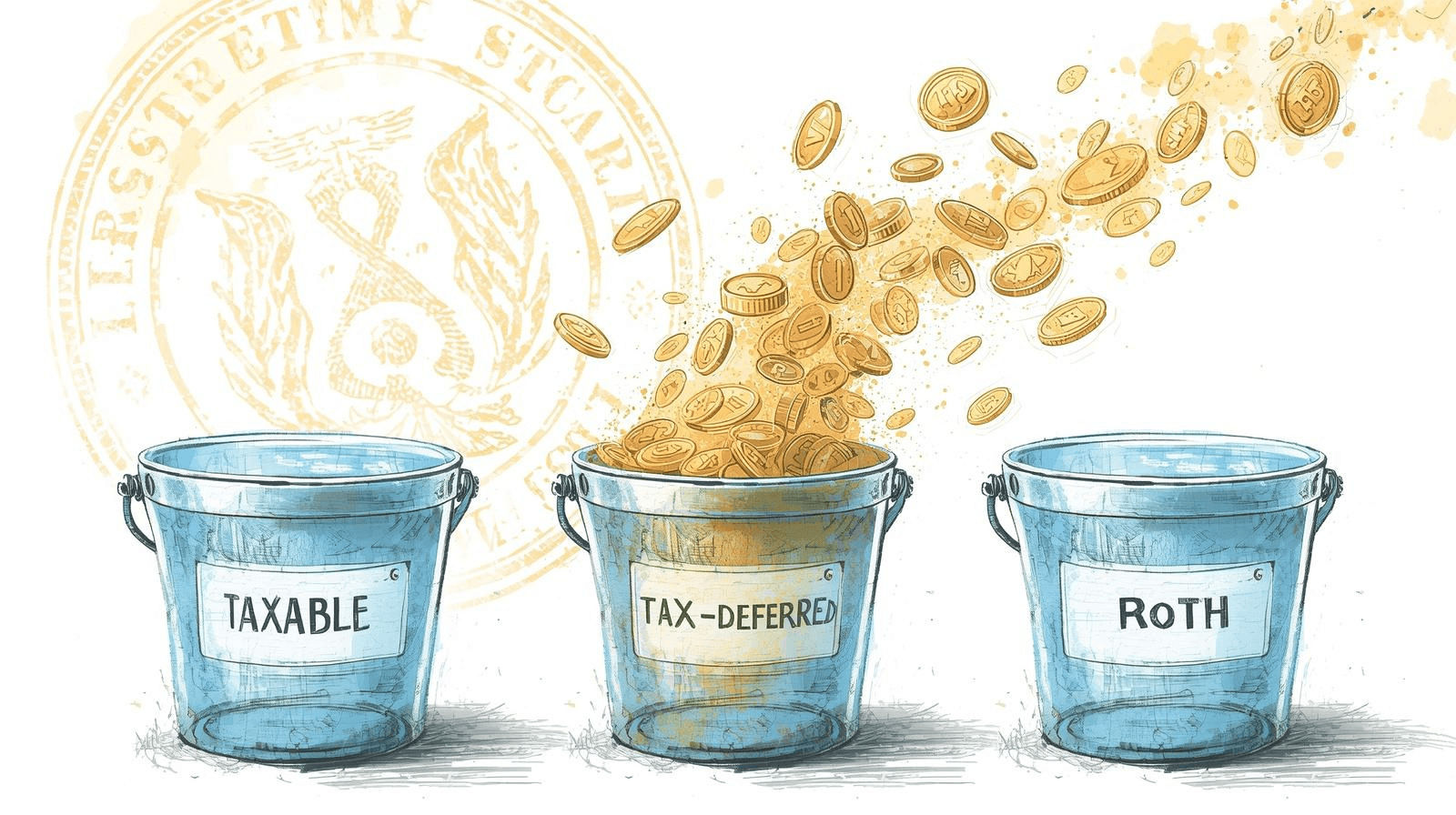
True diversification extends beyond stocks versus bonds. The more powerful distinction for tax purposes is taxable versus tax deferred versus tax free “buckets.” Tax-smart diversification involves blending asset location with tax-efficient vehicles, such as tax-advantaged accounts, to maximize after-tax returns.
Many high-income households arrive at retirement with 80-90% of their assets concentrated in tax deferred accounts like 401(k)s and traditional IRAs. This creates a future tax problem: required minimum distributions starting at age 73 under current SECURE 2.0 rules can push taxable income into the 37% federal bracket, trigger IRMAA surcharges, and inflate the taxable portion of Social Security benefits. The goal of tax diversification is to create lifetime tax efficiency by reducing the total amount of taxes you pay over time.
The Three Account Types
Here’s how each bucket works over your lifetime:
Taxable Brokerage Accounts
Funded with after-tax dollars
Annual taxes on dividends, interest, and realized gains
Long-term capital gains taxed at preferential rates (0-20%)
No contribution limits or withdrawal penalties
Step-up in cost basis at death for heirs
Tax-Deferred Accounts (401(k), 403(b), Traditional IRA)
Contributions often tax-deductible
Growth compounds without annual tax drag
All withdrawals taxed as ordinary income
Required minimum distributions begin at 73
Heirs pay ordinary income tax on inherited amounts
Tax-Free Accounts (Roth IRA, Roth 401(k), HSA)
Funded with after-tax dollars (or converted with taxes paid)
Qualified withdrawals completely tax free
No lifetime RMDs for Roth IRAs
Heirs can inherit tax-free (Roth) or use for medical expenses (HSA)
A Practical Example
Consider a $1 million windfall in 2026. A deliberate three-bucket split might look like this:
$300,000 into taxable accounts for flexibility, including 6-24 months of cash reserves yielding 4-5% in Treasury bills
$400,000 into tax-deferred accounts through maxed solo 401(k) or SEP-IRA contributions (up to 25% of net business income, potentially $250,000+ for recent sellers). Contributions to a Traditional 401(k) or IRA are made on a pre-tax basis, reducing your taxable income for the year. Tax-deferred accounts are best suited for tax-inefficient assets that generate high current income, such as REITs and actively managed mutual funds with high turnover.
$300,000 funding Roth conversions or HSAs to create future tax-free income
This three-bucket structure not only optimizes tax outcomes but also helps establish a reliable income stream in retirement, providing predictable cash flow and peace of mind as you draw down assets.
This balanced approach can reduce lifetime taxes by 20-30% compared to placing everything in tax-deferred accounts, according to tax projection models that account for bracket changes, RMDs, and state taxes from 2026-2050.
At Third Act Retirement Planning, tax diversification is built into every written retirement income plan—not handled as an afterthought each April.
Building Your Taxable “Flexibility” Bucket
Taxable brokerage accounts are often underrated in retirement planning. While they don’t offer upfront tax deductions, they provide something equally valuable: flexibility without penalties.
You can access funds at any age without the 10% early withdrawal penalty that applies to retirement accounts before 59½. You benefit from preferential long term capital gains rates (0-20%) rather than ordinary income tax rate treatment. And qualified dividends receive the same favorable rates.
The tax considerations are real but manageable:
Annual 1099s report dividends, interest, and realized capital gains
Each sale triggers taxable gains (or deductible losses). Selling investments in a taxable account can trigger capital gains taxes, but these can be minimized through strategic planning.
Capital losses from selling underperforming investments can be used to offset taxable gains from other investments, reducing your overall tax liability.
Holding periods matter—assets held over one year qualify for long-term rates
Tax-efficient investing approaches for this bucket include broad index ETFs with low turnover, individual municipal bonds for higher-bracket investors, and tax-managed mutual funds designed to minimize distributions.
One powerful legacy benefit: the step-up in basis at death. If you hold $500,000 in appreciated stock until death, your heirs inherit it at current market value with no capital gains tax on the prior appreciation. This makes holding certain appreciated assets in taxable accounts a strategically generous move.
Finally, consider keeping 6-24 months of planned retirement withdrawals in cash or ultra-short Treasury instruments within taxable accounts. This cash buffer prevents forced sales during 20-30% market drops, protecting your long-term portfolio while providing guaranteed income for near-term needs.
Strategically Using Tax-Deferred Accounts
Traditional 401(k)s, 403(b)s, traditional IRAs, and certain annuities function as “tax-later” vehicles. You get deductions or deferrals today, but every dollar coming out—principal and growth—faces ordinary income tax treatment.
The danger? Stuffing all windfall cash into tax-deferred accounts can backfire. If your tax deferred accounts grow to $2-5 million by your early 70s, RMD rules demand roughly 3.8% of your year-end balance as taxable distributions. On a $3 million balance, that’s $114,000 of mandatory taxable income—potentially pushing you into the 32% bracket plus state taxes. Coordinating withdrawals from these accounts is crucial to help keep your income within a lower tax bracket and avoid unnecessary tax spikes.
Compare the math carefully:
Deducting $50,000 today at the 32% rate saves $16,000 in current taxes
But if you withdraw at 24% later, you’ve actually gained from the deferral
However, if future rates rise (possible after the 2025 TCJA sunset), you may face higher taxes than you saved
Key strategies include utilizing tax-deferred accounts for high-income assets, holding growth stocks or ETFs in taxable accounts, and employing tax-loss harvesting to offset gains.
Business owners or professionals who recently sold a business may still access larger contribution opportunities:
SEP-IRAs allow up to 25% of compensation ($69,000 maximum in 2026)
Solo 401(k)s permit $69,000 total contributions
Cash-balance pension plans can enable even larger deductible contributions
But proceed carefully. Every dollar in these accounts eventually emerges as ordinary income—affecting IRMAA Medicare premiums, Social Security taxation, and state income tax. Coordination with your overall income planning is essential.
Tax-Free Growth: The Roth and HSA Advantage
Roth accounts and health savings accounts represent the most powerful tools for tax-smart diversification, offering tax free growth and tax-free qualified withdrawals.
Roth IRAs and Roth 401(k)s work simply: you pay taxes now at known rates, then enjoy completely tax-free qualified withdrawals after age 59½. Under current rules, Roth IRAs have no lifetime RMDs, making them ideal for legacy planning.
Direct Roth IRA contributions phase out at $153,000-$173,000 single MAGI ($242,000-$262,000 joint) in 2026. However, Roth conversions have no income limits—allowing windfall cash to cover taxes on gradual shifts from traditional accounts.
A strategic Roth conversion approach might involve:
Converting $100,000 annually from 2026-2030
“Filling up” the 24% bracket (approximately $200,000 joint threshold)
Using windfall cash in taxable accounts to pay the tax bill
Spreading conversions over a few years to optimize tax efficiency and avoid higher 32% RMD-era taxes on the converted amounts
Consider the numbers: $250,000 in a Roth account at age 60, growing at 7% for 20 years, becomes approximately $1.03 million—completely tax free. The same amount in a traditional IRA might yield only $680,000 after-tax, a 50%+ difference that compounds over generations.
Health savings accounts offer triple-tax advantages:
Tax deduction on contributions ($4,300 individual/$8,550 family in 2026)
Tax-deferred growth on investments inside the account
Tax-free withdrawals for qualified medical expenses
HSAs are particularly powerful due to this triple tax advantage, making them a unique tool for tax-smart diversification.
After age 65, HSAs function as stealth retirement accounts—you can withdraw for any purpose (taxed as ordinary income, like an IRA) or keep using them tax-free for medical costs. Given healthcare’s prominence in retirement budgets, HSAs deserve serious consideration for anyone with a high-deductible health plan.
At Third Act Retirement Planning, we typically model multiple Roth conversion paths using real tax software, projecting lifetime taxes and legacy impact for heirs under different scenarios. The right approach depends on your specific situation, expected income streams, and stewardship goals.

Tax-Smart Asset Location: Putting the Right Investments in the Right Accounts
Asset location is distinct from asset allocation. While allocation determines your overall mix of stocks, bonds, and other investments, location determines which assets live in which type of account—a decision that directly impacts your annual and lifetime tax drag.
Different asset classes generate different types of income:
Interest (taxed as ordinary income)
Nonqualified dividends (taxed as ordinary income)
Qualified dividends (taxed at capital gains rates)
Short-term capital gains (taxed as ordinary income)
Long-term capital gains (taxed at preferential rates)
Tax-inefficient assets, such as those generating interest or short-term capital gains, are best placed in tax-deferred accounts like Traditional IRAs or 401(k)s, while tax-efficient assets—such as index funds or ETFs—should be held in taxable brokerage accounts to benefit from lower long-term capital gains tax rates. For taxable accounts, direct indexing is a personalized, tax-efficient strategy that allows for tax loss harvesting and customization, potentially increasing after-tax returns compared to traditional index funds.
Under 2026 tax laws, ordinary income faces rates up to 37%, while long-term capital gains max out at 20% (plus the 3.8% Net Investment Income Tax for higher earners). This spread creates opportunity: smart asset location can add 0.5-1% in annual after-tax return over decades without increasing investment risk.
For example, a $1 million diversified portfolio at 7% gross return could grow to $4.1 million over 20 years with optimal location versus $3.7 million with suboptimal placement. That $400,000 difference comes purely from tax efficiency—not from taking more investment risk.
Asset location is a core ongoing service at Third Act Retirement Planning, not a one-time setup item. As tax laws change and your portfolio evolves, location decisions require regular attention.
What Belongs in Taxable Accounts
Holdings well-suited for taxable accounts share common characteristics: low ongoing distributions, favorable tax treatment on what they do distribute, and potential for long-term appreciation.
Good candidates include:
Broad U.S. and international equity index ETFs (e.g., Vanguard Total Stock VTI at 0.03% expense ratio)
Tax-managed mutual funds with low turnover (under 10-15% annually)
Individual municipal bonds for higher-bracket investors
Growth-oriented stocks held for long-term appreciation
These vehicles tend to generate relatively low ongoing taxable distributions while providing long-term growth potential. When you do realize gains, holding periods over one year secure the lower long term capital gains rates.
Real-world example: A low-turnover S&P 500 ETF like VOO (0.03% expense, under 2% annual turnover) minimizes unexpected capital gains distributions each December—unlike actively managed funds that might distribute 5-10% of NAV in taxable gains annually.
For higher-bracket investors in states with income taxes, individual municipal bonds offer attractive after-tax yields. A Georgia resident investing in high-quality Georgia general obligation bonds receives income exempt from both federal and state tax. A 3.5% muni yield equates to 5-6% taxable equivalent for someone in the 37% federal bracket plus 5.49% Georgia state bracket.
For clients focused on charitable giving, holding appreciated securities in taxable accounts creates opportunities to donate shares instead of cash—receiving a full fair market value deduction while avoiding all capital gains tax.
What Belongs in Tax-Deferred Accounts
Since every dollar emerging from retirement accounts faces ordinary income tax anyway, these accounts are ideal homes for the least tax-efficient investments.
Good candidates include:
High-yield bond funds generating 5-7% in taxable interest
REIT funds paying nonqualified dividends
Actively managed stock funds with 20%+ annual turnover
Tactical allocation funds that realize frequent gains
The logic is straightforward: if you’re going to pay taxes on ordinary income anyway, shelter the investments that would generate the most ordinary income in taxable accounts.
However, be cautious about overloading tax-deferred accounts if you already have large balances from pre-retirement saving years. Under 2026 RMD rules, substantial balances force substantial distributions—potentially pushing you into higher tax bracket territory and triggering IRMAA surcharges.
Some deferred annuities can simplify guaranteed income planning, providing predictable income streams in retirement. However, these products must be evaluated carefully. Annual fees of 1-2% plus surrender penalties can erode returns, and the income is taxed as ordinary income regardless. For most situations, systematic withdrawals from a diversified portfolio offer better flexibility and lower costs.
Tax deferral is not a substitute for disciplined portfolio oversight. Complex holdings inside these accounts still require monitoring and rebalancing.
What Belongs in Roth and Other Tax-Free Accounts
High-growth, high-expected-return assets are often ideal for Roth accounts. The logic is powerful: if these investments appreciate significantly over decades, all that growth emerges tax-free rather than facing ordinary income tax in a traditional IRA.
Good candidates include:
Small-cap equity funds (historical 9-10% returns)
Growth-oriented stock funds
International equity funds with higher expected returns
Certain alternative investments if available in your Roth
Consider a simple numerical example:
Account Type | Initial Investment | 7% Growth for 20 Years | After-Tax Value (24% bracket) |
|---|---|---|---|
Roth IRA | $250,000 | $1,030,000 | $1,030,000 |
Traditional IRA | $250,000 | $1,030,000 | $783,000 |
The Roth advantage compounds over time and extends to heirs, who can inherit Roth assets tax-free under current rules.
Roth accounts prove especially valuable in retirement years when managing taxable income below IRMAA thresholds (approximately $206,000 joint) and certain capital gains thresholds becomes important. Strategic Roth withdrawals don’t count toward these calculations.
A critical reminder: Roth and HSA investment choices should still reflect your risk tolerance, time horizon, and stewardship values—not just tax optimization. At Third Act Retirement Planning, we integrate biblical wisdom about prudent money management with tax-efficient positioning, ensuring your portfolio serves your financial goals and your values.
Managing Capital Gains and Losses Without Undermining Your Strategy
Windfall recipients often make large, one-time investment changes that trigger avoidable taxable gains. Selling a concentrated stock position, liquidating inherited assets, or rebalancing a suddenly-larger portfolio can create substantial tax bills if not staged carefully. Realizing capital losses can help offset gains and minimize the amount you owe taxes at year-end, making your overall tax outcome more efficient.
A deliberate plan can spread sales across calendar years, managing your taxable income level and keeping you in lower brackets. Tax-loss harvesting—selling investments at a loss to offset gains—is particularly beneficial during bear markets when asset prices are lower, allowing you to strategically use capital losses to reduce your tax liability. This is especially important in 2026—parts of the 2017 Tax Cuts and Jobs Act are scheduled to sunset at the end of 2025 under current law, potentially changing rates and thresholds.
Short-Term vs. Long-Term Treatment
The distinction matters enormously:
Holding Period | Tax Treatment | 2026 Maximum Rate |
|---|---|---|
1 year or less | Ordinary income | 37% (+3.8% NIIT) |
More than 1 year | Long-term capital gains | 20% (+3.8% NIIT) |
For a $2 million appreciated stock position, the difference between short-term and long-term treatment could exceed $340,000 in federal taxes alone.
Practical staging example: Instead of selling $2 million in appreciated stock in one year (triggering 20%+ long-term rates on most of the gain), consider:
Selling $500,000 annually over four years
Staying in the 15% capital gains tier (under $609,350 joint)
Saving approximately 5% on each year’s gains
Total savings: potentially $100,000+ over four years
The Net Investment Income Tax adds 3.8% on investment income when modified AGI exceeds $250,000 joint. Windfall recipients often exceed this threshold, making strategic staging even more valuable.
Using Tax-Loss Harvesting Wisely
Tax loss harvesting involves realizing losses in taxable accounts to offset realized gains—and then up to $3,000 of ordinary income in a given year. Unused losses carry forward indefinitely. Tax-loss harvesting can help maintain your portfolio's exposure while realizing tax benefits.
Basic mechanics:
Identify positions trading below your cost basis
Sell to realize the loss
Use losses to offset gains dollar-for-dollar
Apply excess losses against up to $3,000 of ordinary income
Carry remaining losses to future years
The wash-sale rule prevents gaming: you cannot repurchase substantially identical securities within 30 days before or after the sale. The rule specifically disallows losses if you buy back the same investment within 30 days of selling it at a loss. However, you can maintain market exposure by swapping similar (but not identical) investments—for example, selling an S&P 500 ETF and immediately buying a total market ETF.
Tax-loss harvesting proves most meaningful when clients expect ongoing realized capital gains from:
Annual portfolio rebalancing
Business sales or real estate transactions
Liquidating concentrated stock positions
Receiving capital gains distributions from mutual funds
The effectiveness of tax-loss harvesting strategies can diminish over a few years as holdings age and market conditions change, so it is important to monitor opportunities, especially after notable market events. The strategy typically adds 0.2-0.5% annually after accounting for effort and transaction costs. However, be cautious about paying high advisory fees or fund expenses solely for automated tax-loss harvesting—the long-run benefit may not justify 0.25% AUM costs for portfolios under $5 million in taxable accounts.
At Third Act Retirement Planning, tax-loss harvesting is used opportunistically—usually during meaningful market pullbacks of 10% or more—in the context of an overall risk and asset allocation plan. We don’t let tax tactics drive investment decisions that could undermine your long-term strategy.

Integrating Charitable Giving and Legacy Planning into Your Tax-Smart Diversification
Generosity can be tax-efficient. Smart giving choices reduce current or future taxes while advancing causes you care about and aligning with biblical stewardship values.
Windfall recipients often want to help family, church, and favorite charities. But ad-hoc gifts can accidentally increase taxes or unbalance an estate plan. A $100,000 cash gift to your church, for example, provides a tax deduction—but donating $100,000 in appreciated stock might provide the same deduction while also avoiding $20,000+ in capital gains tax on the embedded appreciation.
For higher-level techniques, charitable remainder trusts (CRTs) allow donors to create an income stream for themselves or their beneficiaries while ultimately benefiting charitable organizations. This approach can provide predictable payments during retirement and support your legacy goals.
The integration of charitable giving into your tax-smart strategy requires coordination. At Third Act Retirement Planning, we routinely work with estate attorneys and CPAs to design multi-generation plans that honor your values while maximizing the impact of your giving.
Charitable Strategies That Complement Tax-Smart Diversification
Several specific strategies deserve consideration:
Donor Advised Funds (DAFs)
Donor advised funds have become increasingly popular—DAF assets exceeded $230 billion by 2025, growing roughly 10% annually. The structure is straightforward:
Contribute appreciated securities at fair market value
Receive an immediate itemized tax deduction (up to 30% of AGI for stock contributions)
Pay no capital gains tax on the appreciation
Grant to ministries and nonprofits over time as you choose
Example: Contributing $100,000 in appreciated stock (with $20,000 cost basis) to a DAF:
Deduction: $100,000 (potentially $24,000-$37,000 in tax savings depending on bracket)
Capital gains tax avoided: $18,000-$20,000
Total tax benefit: $42,000-$57,000
Funds available to grant to your church and charities over 10+ years
Qualified Charitable Distributions (QCDs)
For those 70½ and older, QCDs route up to $105,000 (2026 limit) directly from your IRA to qualified charities. The distribution:
Satisfies required minimum distributions
Is excluded from adjusted gross income entirely
Reduces IRMAA exposure and Social Security taxation
Accomplishes your giving goals with pre-tax dollars
Appreciated Stock Gifts
Donating highly appreciated positions from taxable accounts to charity resets your portfolio risk and cost basis while avoiding all capital gains tax. This approach particularly makes sense for concentrated positions you’d want to reduce anyway.
Higher-Level Techniques
For very large windfalls ($1 million+ earmarked for charitable purposes), techniques like charitable remainder trusts provide income streams during your lifetime with the remainder going to charity. These require experienced legal and tax counsel and don’t suit every situation.
The underlying principle unifies these strategies: handling God-given resources in a way that is generous, prudent, and tax-aware. At Third Act Retirement Planning, we help clients align their giving with their values while capturing every available tax benefit.
Coordinating a Lifetime Tax Plan: Why a Fee-Only Fiduciary Matters
True tax-smart diversification is not a one-time transaction. It’s an ongoing plan spanning accumulation, retirement, healthcare, and legacy stages—requiring integration across multiple domains that many investors try to manage separately. The goal of a tax diversification strategy is to create lifetime tax efficiency by reducing the total amount of taxes paid over time and maximizing retirement savings.
The components that must work together include:
Investment accounts and their tax characteristics
Withdrawal order during retirement (taxable first, then tax-deferred, then tax-free last typically optimizes)
Roth conversions timed to fill favorable brackets
Social Security claiming strategies
Medicare premium management through income planning
Charitable giving timing and vehicle selection
Estate and legacy design for children and grandchildren
A written retirement roadmap coordinates these elements, projecting scenarios from 2026 forward through your life expectancy and beyond.
What Fee-Only Fiduciary Means
Third Act Retirement Planning operates as a fee-only fiduciary:
Fee-only means we receive no commissions from product sales. Our compensation comes solely from transparent, AUM-based fees that align our interests with yours. When we recommend a strategy, it’s because we believe it serves you—not because it pays us more.
Fiduciary means we’re legally required to put your interests first. Unlike brokers operating under suitability standards (where recommendations need only be “suitable,” not optimal), fiduciary advisors must recommend what’s best for you, even when alternatives might benefit us.
Thomas Cloud, Jr., founder of Third Act Retirement Planning, is also a Qualified Kingdom Advisor—bringing biblical wisdom to financial planning and treating your resources as a sacred trust rather than simply a portfolio to optimize.
Our Process
Working with Third Act Retirement Planning follows a clear path:
Discovery Call – We learn about your windfall, your existing financial situation, your family, your values, and your concerns about the future
In-Depth Analysis – Our team examines your windfall source and tax implications, existing holdings, retirement projections, estate documents, and current tax situation
Customized Tax-Aware Plan – We develop a written retirement and legacy plan integrating account structure, asset location, Roth conversion strategies, withdrawal sequencing, and charitable giving
Ongoing Reviews – We meet regularly to adjust for tax law changes (like potential TCJA sunset effects), life events, and evolving goals
The difference between a random windfall response and a deliberate plan can mean hundreds of thousands of dollars over your lifetime. More money remains with your family and your favorite charities. Less goes to the IRS as a voluntary bonus.

Taking the Next Step
If you’ve recently experienced a windfall—inheritance, business sale, NIL deal, settlement, or any other sudden wealth event—the decisions you make in the next few months will shape your financial future for decades.
A tax smart investment strategy doesn’t happen by accident. It requires understanding your specific situation, modeling multiple scenarios, and making coordinated decisions across investment accounts, tax planning, retirement projections, and legacy design.
At Third Act Retirement Planning, we specialize in exactly this work. Our fee-only, fiduciary approach ensures you receive advice designed solely to benefit you and your family. Our integration of biblical stewardship principles means your plan reflects not just financial optimization, but purposeful management of the resources entrusted to you.
Tax-smart diversification isn’t about avoiding taxes entirely—that’s neither possible nor the goal. It’s about paying only what you owe, when it makes sense, while building wealth that serves your family and values for generations.
Ready to explore how to diversify wisely without giving the IRS a voluntary bonus?
Schedule a discovery call with Third Act Retirement Planning today. We’ll discuss your specific windfall situation, answer your questions, and help you understand whether our approach fits your needs.
Your windfall represents both opportunity and responsibility. The right plan transforms a one-time event into lasting, purposeful wealth. Let’s build that plan together.