Mar 16, 2026
Roth IRA Conversions After a Windfall: Building Tax-Free Wealth for the Future
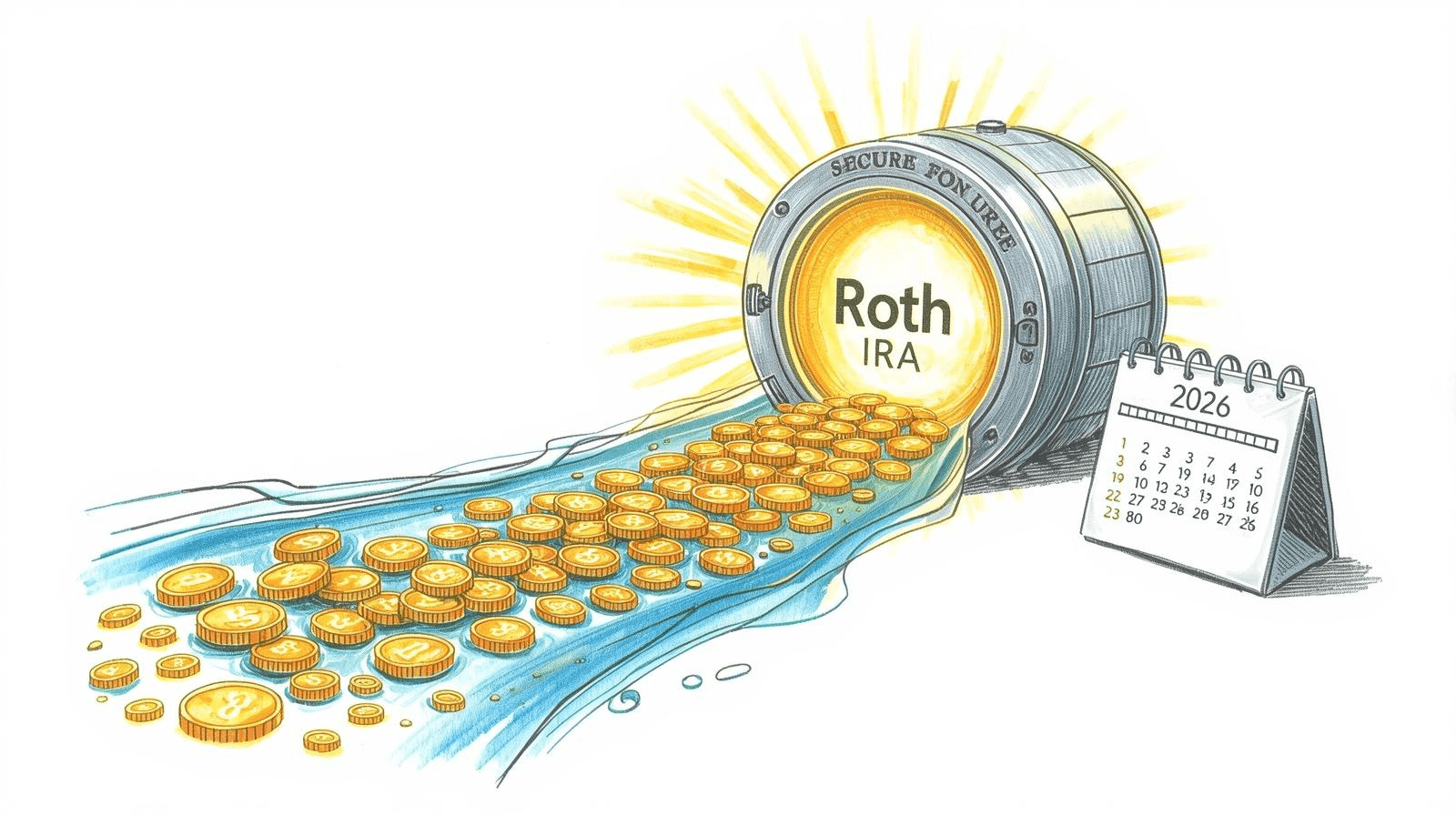
A sudden influx of wealth changes everything—including your tax strategy. Roth IRA conversions involve paying taxes today on the amount you convert, which can be a strategic move to reduce future tax burdens. If you’ve recently come into significant money through inheritance, a business sale, or another windfall, understanding how a roth ira conversion fits into your financial picture could save you hundreds of thousands in lifetime taxes.
Answer First: Should You Consider a Roth Conversion After a 2024–2025 Windfall?
It depends—but for many sudden-wealth households, the answer leans toward yes.
If you received a large windfall in 2024–2025 and hold substantial pre-tax retirement savings, converting part of your traditional ira to a roth ira can reduce your lifetime tax burden and build tax free income for the 2030s–2040s. The strategy works best when:
Your current tax brackets are lower than you expect them to be in retirement
You have at least 10–15 years before needing the funds
You can pay taxes on the conversion from non-IRA cash (potentially from the windfall itself)
Legacy planning for heirs matters to you
There is a trade-off involved: by converting now, you pay taxes upfront on the converted amount, but this can lead to greater tax-free growth and withdrawals in the future, supporting long-term wealth building.
At Third Act Retirement Planning, we specialize in helping sudden-wealth clients identify their optimal conversion “windows”—before the 2026 TCJA sunset, before RMD age, or before selling a business. When considering tax brackets, keep in mind that income thresholds and eligibility for certain tax benefits may differ for single filers compared to joint filers, so it’s important to factor your filing status into your decision-making process.
The rest of this article walks through rules, examples, and a process to decide how much to convert and when.
Roth IRA Basics and Why Windfall Recipients Should Care
Moving money from “tax-deferred” to “tax-free” in the years immediately after a windfall is one of the most powerful wealth-building moves available. Here’s the foundation:
Roth IRAs are funded with after tax dollars. Qualified withdrawals (after age 59½ and the 5-year rule) of both contributions and growth are completely tax free under current tax laws.
Traditional IRAs and 401(k)s are typically funded pre tax or with deductible contributions. Distributions are taxed as ordinary income at whatever tax rates apply when you withdraw.
A roth conversion—sometimes called moving an IRA into a Roth—moves dollars from a traditional ira or 401(k) into a roth ira. The converted amount counts as taxable income in that calendar year—but future growth is forever tax free.
Roth IRAs also escape required minimum distributions rmds during your lifetime, while traditional IRAs now require distributions starting at age 73 or 75 under the SECURE Act changes.
If you have a $2M traditional IRA and just inherited another $1M, you may be sitting on a future tax time bomb. Converting portions now, while you control the timing and brackets, deserves serious consideration.
Understanding the Secure Act and Its Impact
The Secure Act, which took effect in 2020, brought sweeping changes to the way retirement accounts—especially IRAs—are handled after the account holder’s death. For affluent families and high net worth individuals, one of the most significant shifts is the new rule requiring most non-spouse beneficiaries to fully distribute inherited IRAs within 10 years. This “10-year rule” can dramatically increase taxable income for heirs, as they may be forced to take larger withdrawals over a shorter period, potentially pushing them into higher tax brackets and increasing their overall tax burden.
For those who have recently experienced a windfall, this change makes careful planning around Roth IRA conversions even more critical. By converting a traditional IRA to a Roth IRA, you pay income taxes on the conversion amount today, but the funds then grow tax free and are not subject to required minimum distributions (RMDs) during your lifetime. When your heirs inherit a Roth IRA, they still must withdraw the funds within 10 years, but those withdrawals are tax free—eliminating the risk of a sudden spike in taxable income and preserving more wealth for future generations.
The Secure Act also raised the age for required minimum distributions from traditional IRAs, giving account holders more flexibility in their retirement plan. Additionally, it made changes to qualified charitable distributions and other aspects of retirement savings, underscoring the importance of staying up to date with evolving tax laws.
For families focused on legacy planning, Roth IRA conversions offer powerful estate planning advantages. Not only do they help reduce future estate taxes and required minimum distributions, but they also provide beneficiaries with tax-free income, supporting long-term goals like charitable giving or multi-generational wealth transfer. However, the decision to convert—and how much to convert—should be made with a clear understanding of your current and future tax brackets, investment performance, and overall retirement income needs.
Given the complexity of these rules and the potential impact on your estate, working with a qualified tax advisor or financial advisor is essential. At Third Act Retirement Planning, we help clients navigate the Secure Act’s implications, designing strategies that maximize tax benefits, minimize tax burden, and ensure your retirement savings grow tax free for you and your loved ones.
Incorporating Roth IRA conversions into your comprehensive retirement plan can be a strategic way to manage the effects of the Secure Act, reduce taxable income for your heirs, and achieve your long-term legacy planning objectives. With careful planning and expert guidance, you can turn today’s windfall into tomorrow’s tax-free wealth—benefiting both your retirement and the generations that follow.
Why a Windfall Can Be the Perfect Time for Roth Conversions
A windfall can change your tax picture overnight, creating both pitfalls and planning opportunities.
Common windfall triggers include:
Business sales in 2024–2026
Seven-figure inheritance after a parent’s death
NIL contracts for collegiate athletes
Legal or insurance settlements
Stock option exercises
Windfalls often create temporarily flexible years. You may have high asset values but relatively low earned income if you’ve exited a business, stepped away from work, or are spacing out recognition of sale proceeds. This creates ideal conditions for conversions at lower tax brackets.
Using part of the windfall cash—not the ira itself—to pay conversion taxes allows more of the retirement account to move into Roth status. This keeps future RMDs and taxable Social Security benefits lower.
Many windfall recipients want to “lock in” a portion of their new wealth as future tax free growth for retirement and heirs. Roth conversions are one of the only IRS-sanctioned ways to accomplish this.
Financial advisors can help windfall recipients evaluate their options and develop a comprehensive strategy for Roth conversions, ensuring that tax implications, long-term goals, and legacy planning are all considered.

Tax Rules, Five-Year Clocks, and 2026 Sunset Risks
Timing and rules matter. Misunderstanding the five-year clock or the coming 2026 tax changes can undermine a good strategy.
Two separate five-year rules apply:
Main 5-year rule: Five years from your first Roth contribution or conversion before earnings become tax free
Conversion penalty clock: Each conversion has its own 5-year clock for avoiding the 10% early-withdrawal penalty on converted principal (if under 59½)
If you start conversions in 2024, the main clock ends January 1, 2029. Conversions in 2025 have their penalty clock ending January 1, 2030.
The 2026 sunset creates urgency. Current marginal tax rates under the 2017 Tax Cuts and Jobs Act are historically low. Without new legislation, they’re scheduled to increase after December 31, 2025.
Example: A $200,000 conversion in 2025 at the 24% bracket costs $48,000 in federal income taxes. The same conversion in 2027, if brackets rise to 28%, costs $56,000—an $8,000 difference on a single conversion.
Additionally, converting assets when their value is temporarily depressed—such as during a market downturn—can result in a reduced amount of taxable income, optimizing the long-term benefits of the conversion.
Remember: conversions must be completed by December 31 each year. Planning needs to start by fall at the latest.
Case Study: Using a 2024 Inheritance to Build Tax-Free Wealth
Mark and Lisa, both 58 and living in Marietta, Georgia, received a $1.2M inheritance in mid-2024. Mark has a $2.3M traditional IRA; Lisa has a $400K 401(k). They plan to retire at 62 and claim Social Security at 67. They have adult children and want to give charitably through their church.
Their 2024 earned income is lower because Mark sold his small business in late 2023 and now does only part-time consulting. This keeps them within the 24% bracket.
Working with Third Act Retirement Planning, they decided to:
Convert $150,000 per year from Mark’s IRA to a Roth from 2024–2028
Stay below the top of the 24% bracket each year
Pay conversion taxes from the inherited brokerage account, not the IRA
By age 73, their traditional IRA balance—and corresponding required minimum distributions—will be significantly lower. Meanwhile, their Roth balance will have grown to a projected seven-figure tax-free pool.
The legacy impact: Upon their deaths, their children inherit a Roth IRA subject to the 10-year rule under the SECURE Act requires. But with no income taxes on the withdrawals, the children gain more flexibility and potential for generous giving.

Advanced Roth Conversion Strategies for Sudden-Wealth Households
Once basics are covered, affluent families can layer additional investment strategies around conversions to fine-tune tax outcomes.
Roth conversion laddering spreads conversions over 5–10 years to fill specific tax brackets. For 2024 joint filers, converting up to the top of the 24% bracket (around $383,900 of taxable income) maximizes benefit without spilling into the 32% bracket. Note: thresholds change annually.
Market timing opportunities: Converting shares after a 20% market pullback means future recovery happens inside the Roth. Investors who converted during March 2020 or late 2022 captured significant tax free growth when markets rebounded.
Pairing conversions with charitable giving offers additional tax benefits:
Qualified Charitable Distributions after age 70½
Donor advised funds funded in high-income years
Large charitable gifts to offset increased investment income from conversions
State tax considerations matter. Georgia offers retirement income exclusions after certain ages. Some clients accelerate conversions before or after relocating across state lines based on state tax rates.
Third Act Retirement Planning, as a fee-only fiduciary, coordinates these strategies across investments, taxation, estate planning, and charitable goals rather than treating the ira conversion as a one-off transaction.
Coordinating Roth Conversions with Estate & Legacy Planning
Sudden wealth often raises the question: “How do I bless my family and causes I care about, not just the IRS?”
The SECURE Act’s 10-year rule forces most non spouse beneficiaries to empty inherited traditional IRAs within 10 years—potentially pushing them into higher brackets. Inheriting a Roth IRA is different: beneficiaries still must withdraw within 10 years, but tax free withdrawals mean more assets stay with your future generations.
Conversions during parents’ lifetimes become a deliberate act of stewardship: paying taxes at a known bracket today to spare adult children from high tax bills on large inherited IRAs later. For high net worth individuals with multimillion-dollar estates, layering conversions with trusts and charitable bequests creates estate planning advantages.
At Third Act, we integrate biblical stewardship principles—managing windfalls as God’s provision, aiming to be wise and generous stewards across generations.
Common Pitfalls When Converting After a Windfall
A large windfall can tempt people to rush into an oversized conversion without careful planning. Avoid these mistakes:
Converting too much in one year and jumping from the 24% bracket into 35% or 37%, wiping out much of the benefit
Using IRA assets to pay taxes instead of external funds, which reduces tax-advantaged dollars and can trigger penalties if under 59½
Ignoring Medicare IRMAA surcharges for those 65+; even $1 above certain thresholds increases Part B and D medicare premiums two years later
Overlooking interactions with Net Investment Income Tax, phase-outs of deductions, state income taxes, and ACA premium credits for early retirees
Coordination with other windfall decisions matters: business-sale installment payments, stock option exercises, real estate sales, and Social Security timing all affect your strategy.
Tax laws may change again after 2026. Past performance of tax strategies doesn’t guarantee future results—these plans require annual review, not “set and forget.”
How Third Act Retirement Planning Guides You Through Roth Conversions After a Windfall
Third Act Retirement Planning is a fee-only, fiduciary wealth management firm in Marietta, Georgia, focused on individuals and families navigating sudden wealth.
Our process includes:
Discovery call to understand your windfall source, current and projected tax picture, retirement plan timeline, and stewardship goals
Custom Roth conversion roadmap spanning multiple years, showing estimated tax costs, impact on future RMDs, projected Roth balances, and legacy outcomes
Integrated advice across retirement income planning, investment management, tax planning, estate and charitable planning, and healthcare planning
As a Qualified Kingdom Advisor, Thomas Cloud, Jr. helps clients align financial decisions with faith convictions, generosity plans, and the desire to leave a purposeful legacy—not just a large account holder balance.
If you experienced a windfall in 2023–2025 and hold significant pre-tax retirement savings, schedule a discovery call before year-end deadlines. Converting after a windfall isn’t just about money—it’s about building tax free wealth for your Third Act and the generations that follow.