Dec 18, 2025
$3 Million Net Worth: What It Really Means, And If It’s Enough
Quick answer: Is a $3 million net worth enough to feel like a “real” millionaire?
The vast majority of Americans will never reach a $3 million net worth. In wealth management and financial planning, individuals or households with $3 million in assets are often classified as high net worth, as this amount is commonly considered the threshold for high net worth status. But for those who do, the question shifts from “Am I wealthy?” to “Is this enough money for my life and financial goals?”
Calculating your net worth: what counts, what doesn’t, and why it matters
Mastering your net worth calculation is absolutely fundamental to achieving optimal personal finance outcomes and securing long-term financial dominance. At its essence, net worth represents a decisive metric—the total value of everything you own minus everything you owe. This strategic calculation delivers crystal-clear insight into your financial position and empowers you to make commanding decisions about your wealth trajectory.
When systematically cataloging your assets, ensure comprehensive inclusion of all retirement vehicles—401(k)s, IRAs, and similar accounts—plus brokerage holdings, mutual fund positions, cash reserves, savings balances, and current market valuations of real estate properties. Never overlook additional investment positions, including business ownership stakes or high-value collectibles. On the liability side, precisely account for mortgage balances, student loan obligations, automotive financing, and outstanding credit card debt—inefficiencies in this calculation are simply unacceptable.
Asset classification demands strategic thinking, however. Liquid holdings—cash, savings accounts, and publicly traded securities—provide immediate accessibility for unexpected financial demands or lucrative investment opportunities. Illiquid positions, particularly real estate holdings or private equity stakes, require months for conversion to cash and experience significant value fluctuations. Your primary residence, while contributing positively to net worth calculations, fails to provide immediate liquidity unless you execute a sale or leverage transaction.
Current data reveals median household net worth in the U.S. reaches approximately $192,700, though this figure varies dramatically across age demographics, income brackets, and geographic regions. Systematic net worth tracking over time provides the most effective measurement tool for financial goal achievement, trend identification, and improvement area recognition—whether targeting debt elimination, retirement contribution optimization, or investment reallocation for superior growth performance.
Through consistent net worth calculation discipline, you secure invaluable financial health intelligence and position yourself to execute superior wealth-building strategies for future financial security.
What does a $3 million net worth actually look like in 2025?
Net worth is simply your assets minus your liabilities—everything you own minus everything you owe. But a $3 million net worth can be constructed in wildly different ways, and the composition matters as much as the number itself.
Here’s a sample balance sheet for a $3M household:
Category | Value |
|---|---|
Primary residence (market value) | $900,000 |
Mortgage balance | -$100,000 |
Home equity | $800,000 |
401(k) and IRA accounts | $1,200,000 |
Taxable brokerage account | $600,000 |
Cash and savings | $150,000 |
Other assets (vehicles, etc.) | $50,000 |
Other debts | -$50,000 |
Total net worth | $2,750,000 |
Adjust those investment balances upward by $250,000, and you’re at exactly $3 million.
Liquid vs. illiquid assets:
Liquid assets include brokerage accounts, retirement accounts (401(k), IRA), and cash—things you can access relatively easily.
Illiquid assets include your primary residence, rental or investment properties, private business equity, and collectibles. You can’t spend home equity without selling or borrowing against it.
These scenarios reflect the financial realities faced by a real family with a $3 million net worth, highlighting how lifestyle and location impact financial planning.
Three realistic $3M compositions:
Tech professional couple in Austin: $900,000 in combined 401(k) balances from 20+ years of maxing contributions, $600,000 in taxable investments from equity compensation, $700,000 home equity in a paid-off house, $800,000 in other investments and cash. Highly liquid and flexible.
Long-time small business owner in the Midwest: $1.2M in paid-off commercial real estate, $400,000 in retirement savings, $700,000 business equity, $700,000 home equity. On paper it’s $3M, but most is tied up in the business and property—creating very different cash flow realities.
Late-career government worker with a pension: $500,000 in TSP/retirement accounts, $600,000 home equity, plus a defined-benefit pension worth roughly $1.9M in present value. Excellent retirement income security, but the “wealth” doesn’t show up as investable assets.
These three households all have approximately $3 million net worth, but their financial well being and spending flexibility differ dramatically.

Is $3 million enough to retire? (Case studies with real numbers)
The answer depends on your spending, your age, and how your assets are allocated. Let’s use the safe withdrawal rate framework to analyze three specific scenarios.
The traditional “4% rule” suggests withdrawing 4% of your portfolio in year one, then adjusting for inflation annually. Recent research often recommends 3-3.5% for early retirees or those concerned about lower future stock market returns.
Case 1: Couple, age 55, $3M net worth, $5,000/month expenses ($60,000/year)
If at least $2.5M is in investable assets, a $60,000 annual withdrawal represents just a 2% withdrawal rate
Historical backtests show this is extremely conservative—even poor sequence-of-returns scenarios rarely deplete portfolios at 2%
This couple can likely retire early with significant margin for unexpected expenses or market downturns
The main risks: healthcare costs before Medicare eligibility at 65, and potential long-term care needs decades later
Case 2: Single person, age 50, $3M, $10,000/month expenses in Los Angeles ($120,000/year)
$120,000 ÷ $3,000,000 = 4% withdrawal rate
This sits right at the edge of traditional guidance, with higher risk tolerance required
In a high-cost city like LA, $120,000 after taxes may cover housing, health insurance, and basic lifestyle without much cushion
Sequence-of-returns risk is significant: a major bear market in the first 5 years could permanently impair the portfolio
Medical expenses before Medicare and California state income tax add pressure
Case 3: Couple, age 65, $3M, $7,000/month expenses with Social Security of $40,000/year
Total spending: $84,000/year
Social Security covers $40,000, so portfolio withdrawals are only $44,000/year
Effective withdrawal rate: $44,000 ÷ $3,000,000 = 1.5%
This is an extremely sustainable position—Social Security acts as a floor, dramatically reducing pressure on investments
Medicare eligibility further reduces healthcare cost volatility
Key factors affecting all scenarios:
Retirement age: Retiring at 45 with $3M is far riskier than retiring at 65 because the money must last 40+ years instead of 25-30. At this point, the decision to retire early or delay retirement can have a significant impact on the sustainability of your portfolio, as each data point in your retirement plan—such as withdrawal rate or age—affects long-term outcomes.
Tax location: Pre-tax retirement accounts (traditional 401(k), IRA) face income tax on withdrawals; Roth accounts don’t; taxable accounts have capital gains considerations
Current income replacement: If you’re used to spending $200,000/year, $3M won’t easily support that lifestyle indefinitely
$3 million vs $1 million: how inflation changed the meaning of “millionaire”
In the early 1990s, having $1 million meant you had arrived. Today, $1 million is a solid foundation but rarely feels like “enough” for a comfortable, multi-decade retirement.
Using historical inflation data: $1 million in 1990 has the purchasing power of approximately $2.3-2.5 million in 2025. This means $3 million today is only modestly more powerful than $1 million was 35 years ago.
Price changes that illustrate this shift:
Category | ~1990 | ~2024-2025 | Change |
|---|---|---|---|
Median U.S. existing home price | $117,000 | $430,000+ | 3.7x |
Gallon of gas | ~$1.00 | $3.30-$4.50 | 3-4x |
Public university tuition (annual) | ~$3,000 | ~$11,000 | 3.7x |
Private university tuition (annual) | ~$15,000 | ~$45,000+ | 3x |
New car (average) | ~$15,000 | ~$48,000 | 3.2x |
Healthcare costs have inflated even faster than general CPI, making retirement planning more expensive for anyone in the U.S.
In lifestyle terms, $3 million today often approximates the sense of financial security that $1 million provided in 1990. The “millionaire” label hasn’t kept pace with economic growth and inflation.
How far does a $3 million net worth go in different parts of the U.S.?
Geography dramatically changes what $3 million “feels” like in practice. A portfolio that funds a luxurious retirement in one location may feel merely adequate in another.
High-cost coastal cities (San Francisco, New York, Seattle, Boston):
Median home prices often exceed $1-1.5 million
Property taxes, state income taxes, and general cost of living consume significant spending power
A family of four spending $180,000/year in San Francisco—on housing, childcare, college tuition savings, and everyday expenses—may feel solidly middle or upper-middle class
At $180,000/year from a $3M portfolio, you’re at a 6% withdrawal rate—historically unsustainable
Medium-cost metros (Denver, Atlanta, Minneapolis, Austin):
Median home prices typically $400,000-600,000
$100,000-120,000 annual spending supports a comfortable lifestyle with travel, dining, and discretionary spending
$3M provides a reasonable 3-4% withdrawal rate for most couples
Lower-cost regions (Midwest small cities, much of the South, rural areas):
Median home prices often under $300,000
$60,000-80,000 annual spending can feel genuinely affluent
A couple with $3M and $80,000/year expenses lives at a 2.7% withdrawal rate—very sustainable
More money for travel, hobbies, and free time pursuits
The geoarbitrage opportunity:
Selling a $1.5M home in a coastal city and relocating to a region where $400,000 buys comparable space can instantly transform your financial picture. That $1.1M difference becomes investable assets generating passive income and investment income for decades.
State income tax differences matter too:
California: top marginal rate ~13.3%
Texas, Florida, Nevada: 0% state income tax
Moving states can effectively increase your after-tax spending by 10%+ annually
Net worth vs investable net worth: why $3M on paper might not feel rich
The distinction between total net worth and investable net worth is crucial for understanding your actual retirement readiness.
Definitions:
Total net worth: All assets minus all liabilities (includes home, vehicles, business equity, collectibles)
Investable net worth: Liquid and semi-liquid financial assets you can actually draw income from (stocks, bonds, retirement accounts, cash)
Example comparison:
Person A | Person B | |
|---|---|---|
Total net worth | $3,000,000 | $3,000,000 |
Home equity | $1,200,000 | $400,000 |
Private business equity | $800,000 | $0 |
Investable assets | $1,000,000 | $2,600,000 |
Annual spending goal | $60,000 | $60,000 |
Effective withdrawal rate | 6% | 2.3% |
Person A is withdrawing 6% from their liquid portfolio to fund $60,000 in spending—a rate that historically leads to portfolio depletion within 15-20 years. Person B is withdrawing just 2.3%, which is extremely conservative.
The “house rich, cash poor” trap:
Many households in expensive markets find themselves with enormous home equity but limited liquid assets. They’re wealthy on paper but can’t easily convert that wealth into spending money without:
Selling the home (often emotionally difficult and triggers capital gains)
Taking a home equity loan or reverse mortgage (adds debt and interest costs)
Downsizing (requires major life changes)
Rule of thumb: Aim for at least $1 million in fairly liquid, income-producing investable assets before counting your primary residence when assessing retirement readiness. Real estate that isn’t generating rental income doesn’t pay your grocery bills.
How your $3 million net worth compares by age and percentile
Where does $3 million place you relative to other Americans? The Federal Reserve’s Survey of Consumer Finances provides the most reliable data on household wealth by different age groups.
Approximate net worth percentiles by age (based on recent data):
Age Group | Median Net Worth | Top 10% Threshold | Top 5% Threshold | Top 1% Threshold |
|---|---|---|---|---|
35-44 | ~$135,000 | ~$850,000 | ~$1,400,000 | ~$4,500,000 |
45-54 | ~$250,000 | ~$1,500,000 | ~$2,500,000 | ~$7,500,000 |
55-64 | ~$360,000 | ~$2,100,000 | ~$3,500,000 | ~$10,000,000 |
65-74 | ~$410,000 | ~$2,400,000 | ~$4,000,000 | ~$12,000,000 |
What this means for someone with $3 million:
Households in their 40s with $3M are likely in the top 1-2% for their age
Households in their 50s-60s with $3M are typically around the top 5-10%
At any age, $3M is well above median household net worth
Average vs. median—why the distinction matters:
Average net worth is heavily skewed by extreme wealth at the top. Billionaires pull the average far above what typical households experience. The median net worth (the middle household) is a much better benchmark for “normal.”
When you read that the “average” American household has $750,000 in net worth, remember that most recent data shows the median is closer to $192,000. Rich people at the top dramatically skew the average.
Use comparisons as context, not anxiety fuel. Whether you’re in the top 5% or top 15% matters less than whether you’re on track for your own financial future and retirement savings goals.
Building wealth with home equity: how your house fits into the $3 million equation
For strategic wealth builders, home equity represents one of the most significant—and often underutilized—components of net worth accumulation. As mortgage principals decrease and property values appreciate, equity builds systematically—creating substantial wealth that demands strategic consideration. Current data reveals average homeowner equity exceeding $150,000, making this asset crucial for anyone pursuing million-dollar net worth targets and beyond.
However, recognizing home equity's illiquid nature is fundamental to effective wealth management. Unlike liquid retirement accounts or cash positions, accessing home equity requires decisive action—selling the property, securing home equity financing, or establishing credit lines. Each approach demands careful evaluation of timing, costs, and strategic objectives.
Smart wealth builders leverage home equity strategically—not passively. Utilizing home equity loans for high-return investments, debt consolidation at favorable rates, or additional property acquisitions can significantly accelerate wealth accumulation. The key lies in maintaining optimal balance between illiquid home equity and accessible investment vehicles, ensuring sufficient flexibility for retirement objectives and financial goals.
When targeting $3 million net worth benchmarks, position your home as a strategic wealth cornerstone—not your complete foundation. Combining substantial home equity with diversified retirement accounts, investment properties, and liquid assets creates a robust, optimized portfolio capable of supporting comprehensive retirement objectives. Strategic diversification eliminates single-asset dependency while maximizing long-term wealth potential.
Real estate investments: can property push you over the $3 million mark?
Real estate investments represent a decisive wealth-building strategy I consistently recommend for reaching that critical $3 million net worth threshold. Beyond your primary residence, strategic property acquisitions—rental homes, multi-family units, or carefully selected real estate investment trusts (REITs)—deliver both appreciation potential and systematic passive income generation that I find exceptionally compelling.
Property ownership creates reliable cash flow streams that I leverage to cover operational expenses and fuel portfolio expansion. As property values appreciate and mortgage principals decrease, equity accumulation accelerates dramatically, driving overall asset growth. Based on my systematic analysis, real estate investments consistently deliver annual returns in the 8-12% range—making them an indispensable complement to retirement accounts and mutual funds in any serious wealth-building strategy.
However, real estate investing demands strategic precision, not passive hope. Market fluctuations are inevitable, and property management requires dedicated time, focused effort, and calculated risk tolerance. Economic growth patterns, local market dynamics, and your personal risk capacity all factor into my assessment of whether real estate aligns with your specific financial objectives.
To optimize results, I implement diversification strategies that integrate real estate with complementary investments like stocks, bonds, and retirement accounts. This approach systematically balances risk exposure while ensuring you're not dangerously concentrated in any single asset class. For example, a strategically chosen rental property generates immediate passive income, while your mutual funds and retirement accounts provide essential liquidity and growth acceleration.
Ultimately, real estate serves as a fundamental wealth-building driver when executed with strategic precision and integrated thoughtfully into a comprehensive investment framework. Through systematic planning focused on cash flow optimization, value creation, and long-term growth acceleration, property investments become the decisive factor that propels your net worth beyond the $3 million milestone and establishes the foundation for genuine financial security.
Can you retire early at 55 with a $3 million net worth and $5,000 monthly expenses?
This is one of the most common scenarios people with $3 million consider. Let’s break down whether it works.
The scenario:
Age: 55
Net worth: $3 million
Monthly expenses: $5,000 ($60,000/year)
Assumptions: At least $2.5M in investable assets, home either paid off or with modest mortgage payment, no dependent children requiring college tuition support
The math:
$60,000 ÷ $3,000,000 = 2% withdrawal rate
This is significantly below the traditional 4% guidance and well below the 3-3.5% that conservative planners recommend for early retirees. Historical backtests show portfolios at 2% withdrawal rates have essentially never failed over 40-year periods, even accounting for the Great Depression and 2008 financial crisis.
Key risk factors to consider:
Sequence-of-returns risk: A major market downturn in your first 5-10 years of retirement can permanently impair a portfolio, even at conservative withdrawal rates. Keeping 2-3 years of expenses in cash or short-term bonds provides a buffer.
Healthcare before Medicare: From 55 to 65, you’ll need private health insurance. Budget $15,000-25,000 annually for ACA marketplace coverage, depending on your state and subsidy eligibility.
Long-term care: Medical expenses for nursing care or home health aides can run $80,000-150,000 annually later in life. Having a plan (insurance, self-funding, or family support) matters.
Unexpected expenses: Supporting aging parents, helping adult children, major home repairs, and inflation surprises can all strain even comfortable budgets.
What if most of your $3M is in home equity?
If you have a $1.5M house and only $1.5M in investments, your effective withdrawal rate jumps to 4% ($60,000 ÷ $1,500,000). This is far more sensitive to market downturns and reduces your margin for error substantially.
Flexibility helps: Part-time work, consulting, or a passion project that generates even $20,000-30,000 annually in the early retirement years can dramatically reduce portfolio stress and extend longevity.

How to build a $3 million net worth from scratch
Building a $3 million net worth isn’t reserved for tech founders or investment bankers. With discipline, time, and reasonable investment returns, many high-income professionals and diligent savers can reach this milestone.
Path 1: The consistent investor (25-65, 40 years)
Start investing at 25, contribute $1,000/month to tax advantaged retirement accounts and taxable accounts
Assume 7% real (inflation-adjusted) return over 40 years
Result: approximately $2.6 million in investments alone
Add $400,000+ in home equity from a paid-off home, and you’re at $3M+
Path 2: The late-blooming high earner (35-65, 30 years)
Begin serious saving at 35 after paying off student loans and establishing career
Contribute $2,000/month ($24,000/year) consistently
At 7% real return over 30 years: approximately $2.3 million
Combined with home equity and employer matches, easily reaches $3M
Path 3: The aggressive saver (any age, compressed timeline)
Household income of $200,000+, saving 30-40% ($60,000-80,000/year)
Over 20 years at 7% return: $2.5-3.5 million in investments
This requires keeping lifestyle inflation in check despite rising income
Concrete example:
Monthly Investment | Years | 7% Annual Return | Ending Value |
|---|---|---|---|
$1,500 | 30 | 7% | ~$1,800,000 |
$2,000 | 30 | 7% | ~$2,400,000 |
$2,500 | 25 | 7% | ~$2,000,000 |
$3,000 | 20 | 7% | ~$1,500,000 |
Critical success factors:
Max out retirement accounts first: 401(k) employer matches are free money. Tax-deferred compounding in your 401(k) and IRA builds wealth the same way compound interest always has—relentlessly over time.
Keep housing costs reasonable: Buying the biggest house you can “afford” is one of the fastest ways to destroy wealth-building potential. Target housing costs (including mortgage payment, taxes, insurance) at 25% or less of gross income.
Avoid high-interest debt: Credit card debt at 20%+ interest rates works against you with the same exponential math that investments work for you. Eliminate it aggressively.
Stay invested through volatility: Trying to time the stock market consistently destroys returns. The investors who build wealth invest regularly regardless of market conditions.
For late starters (beginning at 40+):
Increase savings rate to 30%+ of income
Consider extending working years into late 60s or early 70s
Explore downsizing housing or relocating to lower-cost regions to free up capital
Focus on catching up contributions in retirement accounts ($7,500 extra annually in 401(k) after age 50)
You don’t need to make more money than everyone else. You need to save and invest consistently, avoid lifestyle creep, and give compound growth time to work.
The psychological side of hitting $3 million: why it may not feel rich
Here’s a paradox: many households with $3 million still experience genuine financial anxiety. The number sounds impressive, but real life often feels different.
Why $3M doesn’t always feel like “enough”:
Rising costs in major categories: Housing, childcare, healthcare, and college tuition have outpaced general inflation for decades. Families in high-cost areas may spend $50,000+ annually on just housing and childcare.
Social comparison: In industries like tech, finance, and medicine, your peers may have $10M, $20M, or more. In wealthy neighborhoods, keeping up with much richer neighbors distorts your sense of where you stand.
Longevity anxiety: With life expectancy extending, a 55-year-old may need money to last 40+ years. That’s a long time to worry about running out.
Concentration risk: If most of your wealth is in one company stock, one rental property, or one business, a single bad event could devastate your net worth.
Examples of $3M anxiety:
A 45-year-old tech worker in Seattle with $3M in company stock watches net worth fluctuate by $200,000-$500,000 in a quarter. The volatility creates stress despite the high balance.
A small business owner with $2M in business equity and $1M in other investments worries constantly about customer concentration, competition, and whether the business will retain value at sale.
Lifestyle creep—the silent wealth destroyer:
As income rises, spending tends to rise in the same way. A nicer car, a bigger house, premium travel, private schools—each individually justifiable, but collectively capable of consuming enormous cash flow. Households earning $400,000 with $350,000 in spending are building wealth slowly despite high income.
Strategies for a healthier relationship with money:
Define your “enough” number: What annual spending level genuinely makes you happy? Often it’s less than peak lifestyle creep spending.
Stress-test your plan: Use conservative return assumptions (5-6% nominal, 3-4% real) and see if your retirement savings hold up over 40 years.
Diversify income streams: Rental income from investment properties, dividend income from a stock portfolio, and Social Security create multiple cash flow sources that reduce dependence on any single one.
Consider working with a fee-only financial planner: A fiduciary advisor can provide objective analysis and help you understand whether your anxiety is justified or excessive.
The goal isn’t to eliminate all financial concern—some vigilance is healthy. But extreme wealth anxiety at $3M often reflects psychological patterns rather than genuine financial risk.
Bottom line: When is $3 million truly enough?
A $3 million net worth can represent:
A robust retirement cushion for those with moderate spending, especially outside high-cost cities
A comfortable but not lavish position for families with high annual expenses or living in expensive metros
A concerning situation if most of the wealth is illiquid or concentrated in a single asset
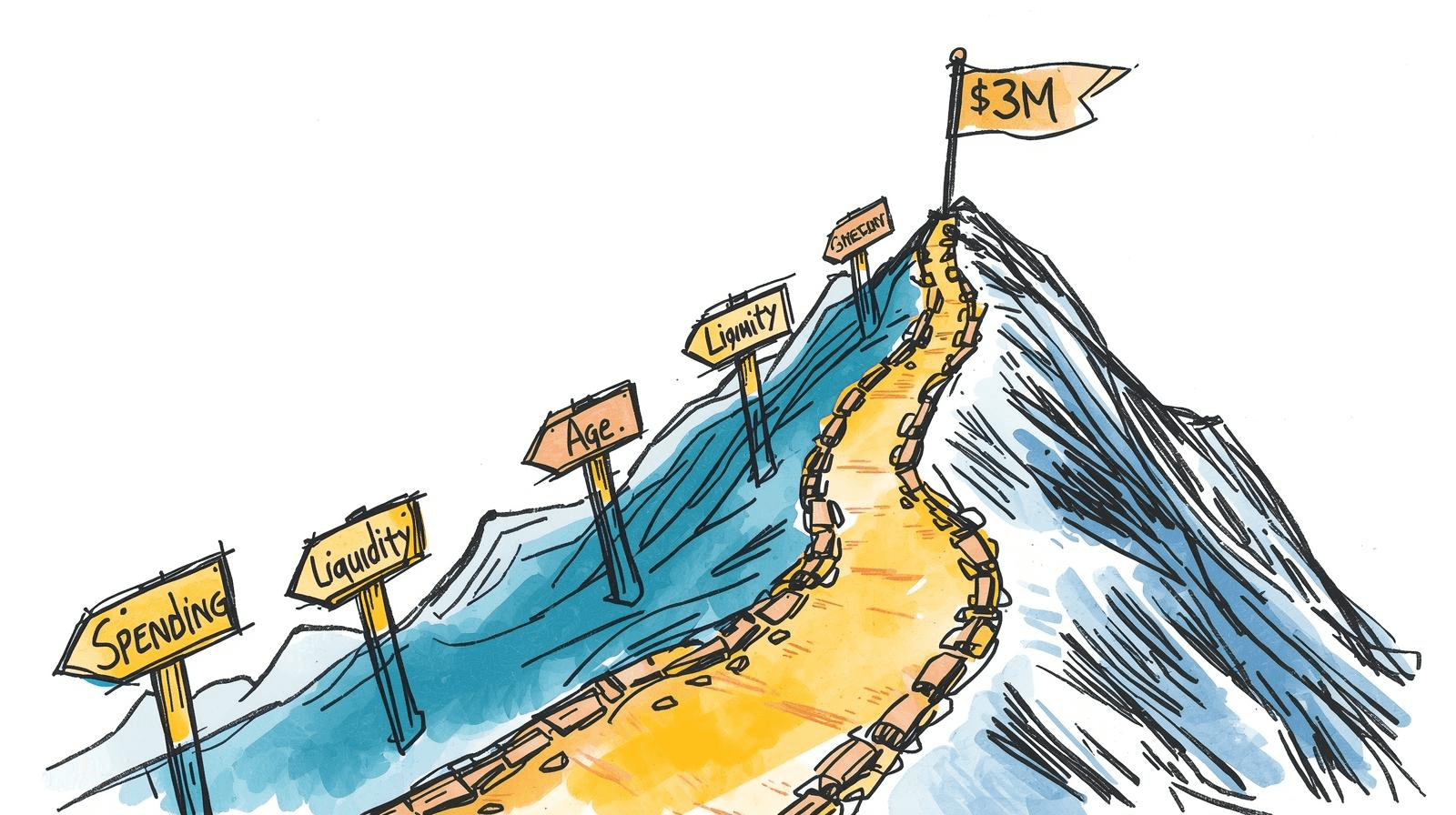
The three factors that determine if $3M is enough for you:
Spending level: What’s your actual annual budget? At $60,000/year, $3M is extremely robust. At $150,000/year, it’s tight.
Retirement age and longevity: Retiring at 55 requires 35-40 years of funding. Retiring at 65 with Social Security requires far less portfolio support.
Asset allocation and liquidity: How much is in liquid assets vs. home equity, business value, and other investments that can’t easily generate cash flow?
A simple self-assessment checklist:
[ ] Target withdrawal rate at or below 3-3.5% of investable assets
[ ] At least $1M in fairly liquid, income-producing assets (not counting primary residence)
[ ] Reasonable expectations around housing costs in your chosen location
[ ] Plan for healthcare costs before and after Medicare eligibility
[ ] Emergency fund for unexpected expenses (at least 6-12 months of spending)
[ ] Some consideration of legacy goals (if applicable)
What to do next:
Rules of thumb are useful starting points, but your situation is specific. Build a detailed plan with your actual numbers—or work with a fiduciary financial planner who can stress-test your projections across multiple economic scenarios.
A $3 million net worth puts you far ahead of the vast majority of American households. Whether it’s “enough” depends entirely on how you build it, where you live, and what you spend. Run your own numbers, be honest about your lifestyle expectations, and make decisions based on your personal financial health—not arbitrary benchmarks or social comparison.
The most valuable thing $3M can buy isn’t a nice car or a bigger house. It’s the option to spend your time the way you choose. Make sure your planning protects that optionality.